


 Damage
  Loss
Loss  Theft
Theft 


How Does an Industrial Heat Pump Work?
As energy costs climb and environmental accountability becomes a business standard, industrial heat pumps have emerged as one of the most effective tools for improving energy efficiency at scale. This article breaks down what heat pumps are, how they function, the components that drive them, and why their performance benchmark leaves traditional heating systems far behind.
What Is an Industrial Heat Pump?
An industrial heat pump is a waste heat recovery system — a technology engineered to capture low-temperature heat that would otherwise be lost and convert it into usable high-temperature energy. Rather than generating heat by burning fuel, heat pumps move heat that already exists, making them fundamentally different from conventional heating equipment.
While a traditional fossil-fired boiler operates below 100% efficiency by definition, a heat pump can deliver efficiency well above 100% — because it transfers more energy than it consumes. This distinction translates directly into lower operating costs, faster returns on investment, and a dramatically reduced environmental footprint.
The Working Principle of a Heat Pump
A heat pump is a closed-loop thermodynamic system that uses electricity to move heat — not create it. Operating on the same vapor compression cycle as a refrigerator or air conditioner, it absorbs heat from a low-temperature source and delivers it at a higher temperature where it is needed. Industrial-grade heat pumps take this a step further, with the ability to reverse the cycle and provide both heating and cooling on demand.
The system runs through four core components: an evaporator, a compressor, a condenser, and an expansion valve. Here's exactly how the cycle works:
-
1Low-temperature waste heat (water) enters the evaporator, the starting point of the cycle.
-
2Heat transfers to the refrigerant inside the evaporator, causing it to evaporate. The source water exits cooler.
-
3Low-pressure refrigerant vapor enters the compressor, where it is compressed into a high-pressure, high-temperature vapor.
-
4Hot refrigerant moves to the condenser, releasing its heat into the process water — which exits at a significantly higher temperature.
-
5Cooled refrigerant passes through the expansion valve, which drops its pressure and temperature, returning it to a low-pressure liquid state.
-
6The cycle repeats continuously as the refrigerant re-enters the evaporator, delivering consistent, reliable heat output.

Heat Pump Efficiency & COP Explained
Efficiency in a heat pump is measured by the Coefficient of Performance (COP) — the ratio of heat energy delivered to electrical energy consumed. A COP of 4 means the system produces four units of heat for every single unit of electricity used.
Modern industrial heat pumps typically achieve a COP between 2 and 6. By contrast, fossil fuel boilers operate at a COP of less than 1 — they lose energy in every cycle. Switching to a heat pump doesn't just trim energy bills; it fundamentally changes the economics of industrial heating.
| System Type | Typical COP | Efficiency |
|---|---|---|
| Industrial Heat Pump | 2 – 6 | 200% – 600% |
| Electric Resistance Heater | ~1 | ~100% |
| Fossil Fuel Boiler | <1 | Below 100% |
By choosing a heat pump solution, facilities can dramatically enhance their energy efficiency profile while reducing measurable carbon emissions — a win for both the bottom line and sustainability reporting.
Key Components of a Heat Pump System
A standard industrial heat pump is built around four essential components, each playing a distinct role in sustaining the refrigeration cycle:
Compressor
The mechanical heart of the system. The compressor pressurizes refrigerant gas, elevating both its temperature and pressure to drive the heat transfer cycle forward.
Refrigerant Circuit
A sealed loop of pipes that continuously circulates refrigerant throughout the system, absorbing and releasing heat at each stage of the cycle.
Heat Exchangers
Two exchangers — the evaporator and the condenser — facilitate the transfer of heat between the refrigerant and the water streams on either side of the system.
Expansion Valve
Controls the flow of refrigerant entering the evaporator. By reducing pressure, it causes the refrigerant to cool rapidly, readying it to absorb heat again.
Types of Industrial Heat Pumps
Heat pumps are available in several configurations, each suited to different source conditions and application environments. Understanding the options helps facilities select the most appropriate system for their specific energy profile.
- Water-to-Water Heat Pumps Extract heat from a water source such as groundwater, rivers, or industrial process streams, and deliver it into a hydronic heating system. Ideal for facilities with access to a stable water supply.
- Air-to-Water Heat Pumps Absorb heat from ambient air and transfer it to a water circuit. Highly versatile and suitable for a wide range of climates and installations, including residential and light commercial applications.
- Air-to-Air Heat Pumps Transfer heat between two air streams — commonly used in building HVAC systems where both heating and cooling capacity is required from a single unit.
- High-Temperature Industrial Heat Pumps Engineered to deliver process heat at elevated temperatures — typically above 100°C — making them suitable for food processing, chemical production, and other demanding industrial sectors.
Environmental Impact & Carbon Reduction
The environmental case for heat pumps is compelling. By relying on electricity rather than combustion, they produce zero on-site carbon emissions. When powered by renewable energy, their lifecycle carbon impact drops even further — making them a cornerstone technology in corporate decarbonization strategies.
Beyond emissions, heat pumps reduce total primary energy consumption. Because they move heat rather than generate it, the demand placed on the power grid per unit of output is a fraction of what a resistance heater or boiler would require. For businesses operating under sustainability targets or carbon reporting obligations, this distinction matters significantly.
Is a Heat Pump Right for Your Operation?
If your facility generates process waste heat, operates heating systems for extended hours, or is working toward energy cost reduction and sustainability benchmarks, an industrial heat pump is worth serious consideration. The combination of high COP ratings, dual heating and cooling capability, and long operational lifespan makes the investment case exceptionally strong across a wide range of sectors — from manufacturing and agriculture to food production and building management.
For residential and light commercial applications, split-system heat pumps offer the same thermodynamic advantages in a compact, easy-to-install format — delivering year-round comfort with industry-leading efficiency.
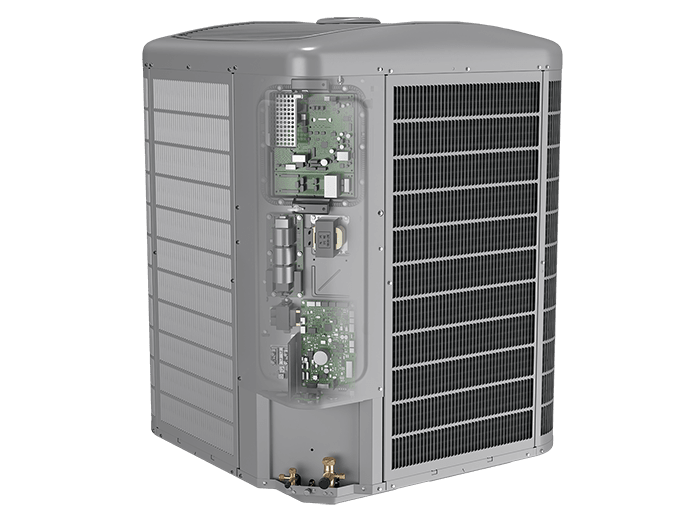
Ready to upgrade your home or facility with a high-efficiency heat pump system? Explore our featured model below.
Armstrong Air 2.5T Heat Pump