


 Damage
  Loss
Loss  Theft
Theft 


Understanding the Scissor Lift Mechanism: How It Works & Why It Matters
Scissor lifts are a staple of industrial and commercial environments — relied upon any time workers need to safely reach elevated heights. From construction and warehousing to energy, entertainment, and advanced manufacturing, these machines are engineered to perform. The type of scissor lift best suited for a job depends on the application, the platform size, the operating height, and the handling demands of the work itself. This guide walks through how the scissor lift mechanism works, what components make it function, and what factors to consider when selecting one.
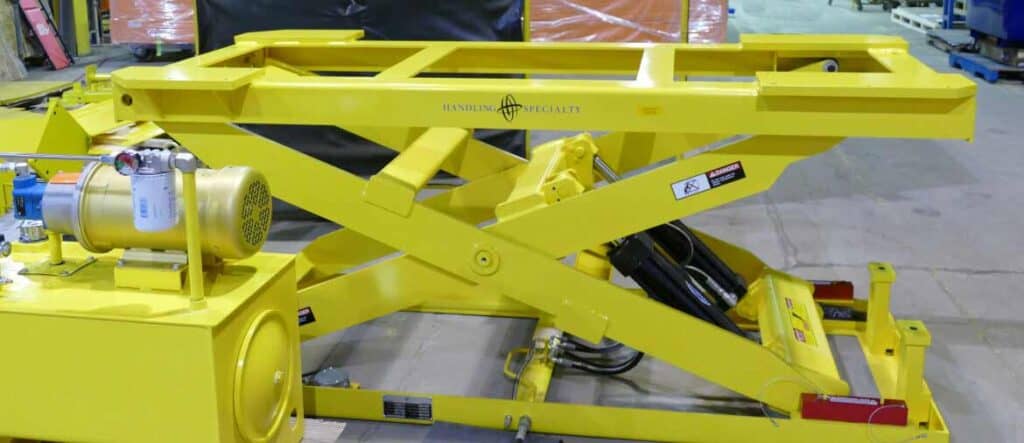
How Does the Scissor Lift Mechanism Work?
The foundational principle of a scissor lift is elegantly mechanical: a set of cross-braced metal arms fold and unfold in an "X" pattern — expanding vertically to raise the platform and collapsing to lower it. This interlocking scissor assembly is what gives the mechanism its name. Depending on the power source, the lift extends upward using hydraulic pressure, pneumatic force, or an electric motor-driven system.
The scissor mechanism operates by pushing and pulling the connected cross-arms through a pivot arrangement — referred to as the pantograph configuration — which ensures the work platform remains level and stable throughout every stage of the lift cycle.
The operator activates the power source — electric motor, hydraulic pump, or pneumatic compressor — initiating pressure through the system to drive the cylinder actuators.
Hydraulic or pneumatic cylinders push outward, forcing the scissor legs to extend. The cross-arm pivot points guide the arms in a controlled, predictable motion — keeping the platform level.
As the scissor legs expand, the work platform is lifted upward. Multiple scissor stages can be stacked for greater height, each additional set multiplying the total elevation range.
Lowering is managed by releasing fluid back through the down valve, which controls flow rate — and therefore descent speed — before the fluid returns to the reservoir.
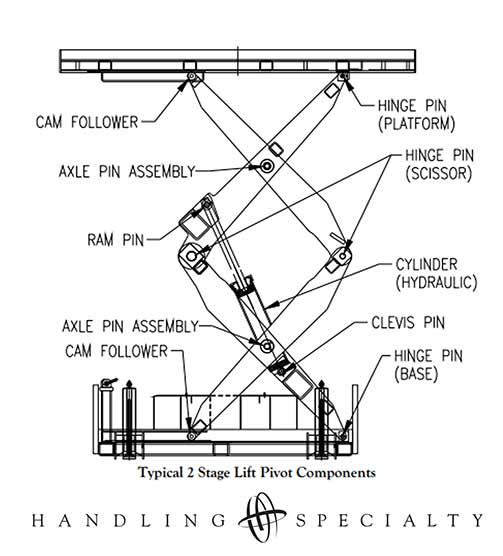 The Scissor Mechanism & Pantograph Assembly
The scissor mechanism earns its identity from the characteristic X-formation of its arms. Support bearings are fixed at pivot points along each leg, constraining the scissor assembly to move in only one direction — straight up and straight down. This is what makes the platform inherently stable.
At its core, the scissor assembly is a pantograph: a series of connected parallelograms that allow the operator to scale the height of the base design while maintaining its footprint and keeping the platform perfectly parallel to the ground surface below.
The rigid geometry of this design is what ensures load remains evenly distributed during operation, preventing tipping or shifting — even when workers move across the platform.
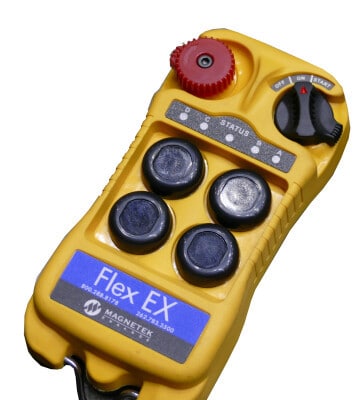
Scissor Lift Control Systems
Modern scissor lifts are operated through one of two primary control systems — mechanical or electronic — depending on the scale and complexity of the application.
Mechanical Control
Traditional scissor lifts have used mechanical lever-and-rack systems for decades. The control table features a foot lever and a hand lever for precise positional adjustments. This compact approach works reliably in confined spaces with minimal electrical complexity.
Electronic & Joystick Control
Modern units use joystick controllers or electronic panels to raise, lower, and reposition the platform with high precision. These systems support both vertical and horizontal movement and can incorporate safety interlocks — such as emergency stop buttons and tilt sensors — for enhanced operator protection.
In hydraulic configurations, a flow control valve governs descent speed by regulating the rate at which fluid leaves the cylinder. This ensures smooth, controlled lowering — even under full load — and prevents sudden drops caused by pressure release. A down valve works in tandem with the flow control valve to manage the return of fluid to the reservoir.
In some configurations, the scissor platform includes a rotary unit that allows the work surface to rotate, giving operators horizontal reach without repositioning the machine — a significant productivity advantage in repetitive workflows.
Scissor Lift Parts & Components
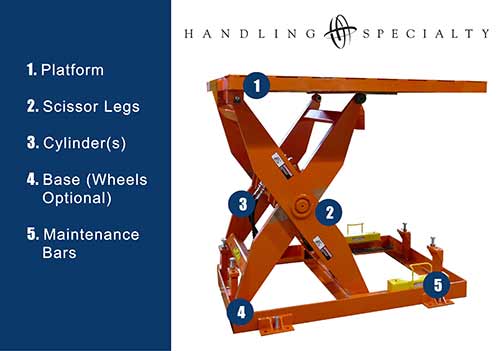
Understanding what makes up a scissor lift helps you evaluate quality, plan maintenance, and match the right unit to your operational needs. Here are the core functional components:
The work surface at the top of the scissor assembly. Often features safety rails and non-slip surfaces. Size and capacity vary by model and application.
Fabricated steel arms arranged in an X-pattern pantograph assembly. Their expansion and contraction directly controls the platform height.
One to four hydraulic or pneumatic cylinders provide the lifting force. Each cylinder is directly coupled to the scissor legs and actuated by pressure from the power source.
A heavy-gauge steel foundation that houses the scissor assembly. The base configuration determines mobility, stability, and the overall footprint of the machine.
Electric motors, diesel engines, or pneumatic compressors depending on the operating environment and required capacity.
Controls the return of hydraulic fluid to the reservoir during descent. The rate of flow through the down valve determines how quickly the platform lowers.
Regulates the speed of ascent and descent by limiting the rate of hydraulic fluid movement. Ensures smooth, consistent motion under varying load conditions.
Scissor lifts designed for mobility include integrated caster wheels or track systems. Maintenance kits cover wear items like seals, filters, and valve components.
Types of Power Source
Selecting the right power source for your scissor lift is directly tied to the environment in which it will be used, the required duty cycle, and emissions constraints.
Zero direct emissions make electric scissor lifts the standard for indoor applications. They operate quietly, typically run on rechargeable battery packs, and are well-suited for warehouses, retail, and enclosed worksites.
Hydraulic scissor lifts use a reservoir of pressurized fluid to drive cylinder action. They offer excellent load capacity across a wide range of scales — from compact tabletop units to heavy-duty industrial platforms.
Diesel-powered units are preferred for outdoor or rough-terrain applications. They generate significant lift force and are not limited by battery charge cycles, making them reliable for long-duration job sites.
Pneumatic scissor lifts operate on compressed air and use no hydraulic fluid — making them suitable for clean environments and smaller-scale applications. They are an economical option where load requirements are modest.
Common Applications
Scissor lifts are deployed across an exceptionally wide range of industries. Their stable platform, predictable vertical travel, and adaptable power configurations make them one of the most universally useful pieces of access equipment available.
- Construction sites requiring overhead structural access and material elevation
- Warehouse and fulfillment operations for high-bay shelving and inventory management
- Automotive and aerospace assembly lines where positioning precision is critical
- Entertainment and stage production setups for lighting and rigging overhead structures
- HVAC, electrical, and plumbing installation in commercial building projects
- Retail and facility maintenance for signage, fixtures, and ceiling-level work
Choosing the Right Scissor Lift for Your Application
No two worksites are identical, and the scissor lift that performs best in one environment may be entirely wrong for another. Here are the key considerations before purchasing or specifying a unit:
Working Height & Platform Size
Start with the maximum height your operators need to reach — then add the average standing height of your workers to determine minimum platform height requirements. Platform size should accommodate both the number of personnel and the materials being handled simultaneously.
Indoor vs. Outdoor Use
Indoor use almost always calls for electric power and non-marking tires. Outdoor applications — particularly on uneven terrain — benefit from rough-terrain models with diesel or dual-fuel power options and wider wheelbases for stability.
Load Capacity
Factor in not just the weight of the workers but all tools, materials, and equipment being carried on the platform. Exceeding load ratings is a leading cause of scissor lift failures and must be avoided entirely.
Duty Cycle & Runtime
For operations requiring continuous use across multiple shifts, consider hydraulic or diesel units. Electric models are well-suited to moderate duty cycles where recharging between shifts is manageable.
Handling Specialty manufactures custom-engineered scissor lift solutions for specific industrial and material handling applications — single-unit custom platforms, automated guided vehicle (AGV) lifts, and large-scale multi-stage systems tailored to precise performance requirements.
Find the Right Leveling & Lift Solution
Explore precision-engineered scissor lift accessories designed for real-world performance and long-term durability — built to match your application demands.
AMGO Leveling Bar & Kits – SX003