


 Damage
  Loss
Loss  Theft
Theft 


The Complete Guide to Swimming Pool Lifts
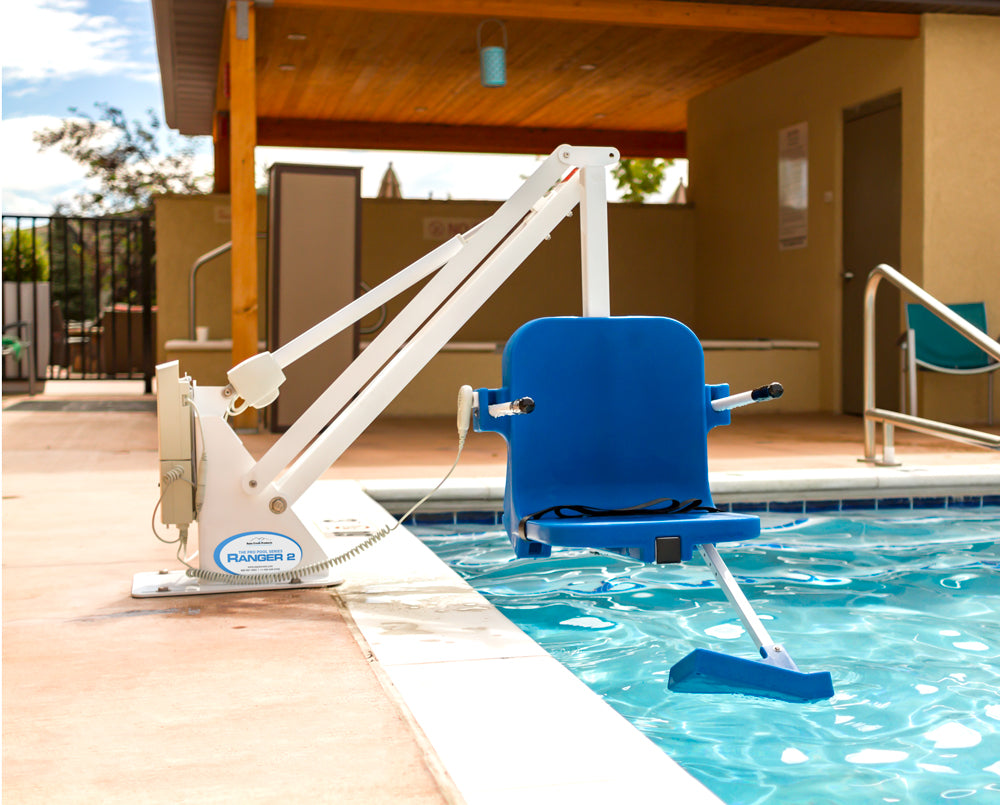
A powered swimming pool lift installed at poolside, providing accessible water entry.
Accessibility has always been a central issue for individuals with disabilities. Long before the Americans with Disabilities Act (ADA) was signed into law, people with physical challenges and their families were already advocating for the removal of social barriers that excluded them from everyday life. Discriminatory practices were widespread, and accessible accommodations were far from the norm.
Over time, advocacy efforts led to major legislative changes. People with disabilities pushed for equal access to transportation, employment, and public spaces through organized awareness campaigns. Congress eventually acted, extending federal protections to cover a wide range of public and private accommodations. However, it took more than two decades before swimming pools were brought under the same accessibility umbrella.
In early 2013, wading pools, spas, and public swimming pools were officially required to be accessible to individuals with disabilities under the ADA. Any facility that failed to comply faced civil penalties of up to $55,000. The regulations had actually been in development for a few years prior — the Justice Department published accessibility standards in 2010 and initially set a March 2012 deadline. When pool operators across the country raised concerns about the timeline and confusion around implementation, the deadline was extended to January 31, 2013, and the rules were further clarified.
It was also confirmed that operators were only required to provide access to their existing pools if doing so was “readily achievable” — meaning it would not cause significant expense or difficulty. Today, any business with a pool or spa must follow ADA requirements. Let’s take a closer look at what those rules entail, how they apply to both commercial and residential settings, and what factors matter when choosing a swimming pool lift.
ADA Requirements for Swimming Pools
If a private or public facility with a pool falls within one of the following two categories, it is required to provide accessible entry and exit for swimming pools and spas under ADA standards:
Public Sector
This includes county, school district, municipality, and city-operated pools and aquatic facilities.
Private Sector
This covers recreation centers, lodging facilities, educational institutions, and similar establishments.
Pools in public or private commercial settings must comply with the following guidelines:
Large pools (over 300 linear feet of pool wall) must provide two accessible means of entry. One must be a sloped entry or pool lift. The second can be any of the five approved methods: transfer walls, pool lifts, accessible stairs, transfer systems, or sloped entries.
Spas must have either a transfer system, transfer wall, or a pool lift installed.
Wading pools are required to have a sloped entry for accessibility.
Smaller pools (under 300 linear feet of wall) must offer at least one accessible means of entry — either a sloped entry or a pool lift.
If a pool uses a portable lift, it must be secured to the pool anchor or deck whenever the pool is open for use.
A non-fixed portable lift is only permitted when installing a fixed unit is not readily achievable.
A fixed portable lift must require tools for removal from its anchored position.
Every water body requires its own dedicated form of access, and each type of accessible entry must be poolside and operational during business hours.
Beyond these core requirements, there are additional questions the ADA addresses for specific scenarios. Let’s explore a few of the most common ones.
Do Community Pools Need to Provide Accessible Entry and Exit?

Pools that belong to private residential communities and are exclusively for residents and their guests generally do not need to comply with ADA accessibility standards. However, if a pool or swimming club within a residential area is open to the general public for use or rentals, it falls under the ADA requirements listed above. Similarly, community pools operated or owned by a local government or state entity must comply with ADA program accessibility mandates.
Are There Tax Deductions or Credits for ADA Compliance?
Yes. The IRS provides incentives for businesses that invest in accessibility improvements. Section 190 of the IRS code offers a tax deduction available to all businesses, while Section 44 provides a tax credit specifically for small businesses. The tax credit applies to businesses with 30 or fewer employees and annual revenue of $1,000,000 or less. This credit covers 50% of eligible accessibility expenditures in a given year, up to $10,000, with a maximum credit of $5,000.
The credit can be applied toward purchasing adaptive equipment, covering the cost of accessibility-related modifications, and eliminating barriers to access.
Tax deductions are available to all businesses with a maximum annual deduction of $15,000. These deductions apply to expenses incurred in removing accessibility barriers and making structural alterations.
Can a Pool Lift Be Shared Between a Pool and a Spa?

For newly built facilities, each pool and spa must have its own dedicated accessible entry and exit. For existing pools, whether each water body needs its own lift or accessible entry depends on whether providing one is readily achievable. If it is not, the facility doesn’t have to shut down — but it should plan to install compliant swimming pool lifts as soon as it becomes feasible.
Sharing a pool lift between multiple pools creates safety hazards. If a swimmer with a disability needs to exit the water and the lift has been moved to a different pool, they may be stranded. This also places an unfair burden on individuals with disabilities, as they would need to rely on staff to locate, transport, and reassemble the lift each time.
Can a Business Store Its Pool Lift and Only Set It Up on Request?
No. A pool lift must remain in place and be operational at all times the pool is open to the public. People with disabilities have long faced challenges with portable accessibility equipment — items going missing, staff being unavailable to help, or workers not knowing how to properly set up the equipment.
Additionally, ADA regulations require that a pool lift be positioned at the correct water depth and with adequate space for wheelchair maneuvering. Frequently moving a portable lift increases the chance that it will be set up incorrectly, which can make it unsafe or difficult to operate.
Key Considerations When Purchasing a Pool Lift
Before investing in a pool lift for your pool or spa, there are several important factors you should evaluate. Choosing the right lift depends on your specific setup, applicable regulations, and the needs of the users it will serve.
Type of Pool or Spa
The kind of pool or spa you have plays a direct role in which pool lift is suitable. Is your pool commercial or residential? If it is a commercial facility, you are required to purchase an ADA-compliant pool lift. Here is an example of an ADA-compliant powered pool lift:
An ADA-compliant powered pool lift in a commercial pool setting.
This means you will need either a permanent or fixed portable pool lift that meets ADA standards. The lift must support a minimum of 300 pounds and provide one or two entry points depending on the size of your pool.
Here are some additional ADA-compliant pool lift options to consider:
• Ranger 2 Powered Pool Lift — ADA Compliant, by Aqua Creek
• Rotational Series Electric Pool Lift R-375 — by Global Lift Corp
• Motion Trek 350 ADA Compliant Pool Lift — by Spectrum Aquatics
• Spa Lift Ultra Pool Lift — by Aqua Creek
That said, one of the most important reasons your pool type matters is because of measurement compatibility. Each pool lift is designed for use with specific pool dimensions to ensure safe operation. If you operate a commercial pool, ADA guidelines require that you select a lift that matches your pool’s specific measurements. Let’s explore some of the key measurement factors.
Deck to Water Draft

Diagram illustrating deck to water draft measurement.
The water draft is the distance measured from the top of your pool deck down to the waterline. Most pools have a water draft of less than 9 inches, which is compatible with the majority of pool lifts on the market. For example, certain models offer a 14-inch deck to water draft range, making them suitable for standard pool configurations. However, if your water draft exceeds 9 inches, you will need a lift with a longer stroke to ensure the seat is submerged at least 18 inches below the surface.
Coping Width

Illustration showing how coping width is measured at the pool edge.
Another critical measurement is the coping width — the ledge that runs along the top edge of your pool. This determines which pool lifts can be properly installed. Standard coping is typically 12 to 14 inches wide, which accommodates most lift models. When installing, the front anchors should be placed a minimum of 4 to 6 inches back from the coping and expansion joint.
Clear Deck Space

ADA clear deck space requirements diagram (36" x 48" minimum).
For commercial pools, ADA guidelines require that the center of the lift seat be positioned at least 16 inches from the pool edge, with a minimum of 36 to 42 inches of clear deck space beside the lift for wheelchair access. An ADA-compliant clear deck space begins at 29.5 inches for a minimum pool lift setback of 14.5 inches. If the setback is up to 19 inches, the clear deck space should start from 34 inches measured from the pool wall.
Pool Depth
For commercial installations, the pool lift must be placed in an area where the water depth is 48 inches or less. The standard acceptable depth range is 42 to 48 inches. If your pool is deeper than 48 inches at the intended installation point, this depth restriction does not apply — but you should verify compatibility with your specific lift model.
Anchoring Your Pool Lift
Pool lifts are available in two main types: portable and permanent. The choice between them depends largely on whether your pool is a private or commercial installation, as ADA requirements govern how commercial pool lifts must be anchored.

A portable electric pool lift on wheels, positioned at poolside.

A permanent powered pool lift with deck anchors at a commercial facility.
Portable Lifts
Portable pool lifts are designed to be movable. If you purchase one, you can relocate it away from the pool for storage or use it at a different location. While this offers flexibility, it comes with restrictions for commercial settings. If your pool must comply with ADA guidelines, a portable lift alone is not sufficient for its intended purpose.
This is because ADA standards require that a pool lift not be moved between locations due to safety and accessibility concerns. If you do opt for a portable pool lift, you will need to install anchor fittings to secure it in place. Here’s what a typical pool lift anchor looks like:

A cylindrical pool lift anchor used for securing portable lifts to the deck.
For residential or private community pools, anchor fittings are not mandatory for portable lifts, though they are still recommended for safety.
Permanent Pool Lifts
Unlike their portable counterparts, permanent pool lifts are not removable and are designed to comply with ADA placement guidelines from the moment they are installed. The lift remains in place at all times, ensuring that individuals with disabilities never have to request assistance to set up or locate the equipment.
Different pool lift models accept different types of anchoring systems. Some can be secured using concrete anchors, while others offer additional options such as wood deck or paver anchors. It is essential to consult the owner’s manual for your specific lift model, as anchoring requirements vary. For example, some lifts can be installed into a standard 6-inch thick concrete deck, while others require a thicker concrete pad for safe support.
Installation methods also differ between models. Some lifts feature a single post that slides into an anchor socket, while others use a jig plate — a mounting plate with 3 or 4 bolts that extend out of the concrete.

Anchor jig plate installation diagram showing hardware components.
If you have an existing anchor and want to retrofit it, many pool lift models allow this using an epoxy or hole saw method. Your installer would drill through the pool deck and use a two-part epoxy sealant to secure the mounting plate.
The required concrete thickness can range from 6 to 10 inches depending on the pool lift model. Some lifts only need the standard 4-inch thick pool deck, making installation simpler and more affordable.

Standard anchor socket used for pool lift installation.
It is important to note that anchor sockets and mounting plates must be bonded in compliance with your local electrical codes. Always hire a qualified installer who understands both ADA anchoring requirements and your local building codes when setting up a permanent pool lift or anchoring a portable one.
Additionally, it is a best practice to consult with your local inspector or county official before installing a permanent pool lift. This ensures your installation, placement, and bonding meet all applicable regulations. Make sure you fully understand the installation guidelines for any pool lift before making a purchase.
Type of Disability
All pool lifts provide transitional support, but they are typically designed with specific types of disabilities in mind. For instance, certain models come equipped with additional features such as chest straps, head supports, or sling seats to accommodate individuals with more significant mobility challenges. However, these extra features may not be necessary for someone with a milder condition like arthritis who simply needs assistance entering and exiting the pool.
Before purchasing a pool lift, carefully consider the type of disability it will need to serve. Matching the lift’s features to the user’s needs will help you avoid unnecessary costs and prevent the need to replace the lift after purchase.
Weight Capacity
For commercial pools, any pool lift must be ADA compliant, which means it must support a minimum weight of 300 pounds. Additionally, pool lifts are required to sustain a minimum static load of one and a half times their rated capacity. The ADA also recommends that facilities provide lifts that meet the needs of the population they serve, so offering a lift with a capacity greater than 300 pounds is often advisable.
For bariatric applications, some pool lifts are specifically engineered to support over 450 pounds:

A heavy-duty aquatic pool lift designed for bariatric use, supporting up to 500 pounds.
Frequency of Use
How often your pool lift will be used is another important consideration. High-traffic commercial pools may require a more robust, heavy-duty lift that can withstand frequent daily use without compromising safety or performance. Residential pool lifts, on the other hand, may experience lighter use and can often be a simpler, more economical model. Consider the expected usage patterns when making your selection to ensure long-term durability and reliability.
Ready to Find the Right Pool Lift?
Browse our selection of high-quality swimming pool lifts designed for accessibility, safety, and durability.
Aqua Creek Portable Pro Pool LiftChoosing the right swimming pool lift is about more than just meeting regulations — it’s about creating a safe, welcoming environment where everyone can enjoy the water. Whether you are outfitting a commercial facility to meet ADA requirements or making your backyard pool more accessible for a loved one, the right lift can make all the difference.
Have questions about choosing the right pool lift for your needs? Reach out to us at Backyard Provider — we’re here to help.