


 Damage
  Loss
Loss  Theft
Theft 


Selecting Mulcher Attachments for Skid Steers and Compact Track Loaders
A Comprehensive Guide to Making the Right Choice for Your Land Clearing Needs
Mulching heads, commonly referred to as forestry mulchers or horizontal drum mulchers, have experienced a significant surge in popularity over recent years. However, successfully achieving your land clearing goals with one of these attachments depends not only on the specific model you select but also on how effectively you utilize it. Performance can be disappointing if the attachment is not properly matched to the skid steer or excavator on which it will be mounted. Similarly, production will suffer if the mulcher is not operated correctly. The following guide provides essential tips on equipment selection and operation to help ensure optimal results.
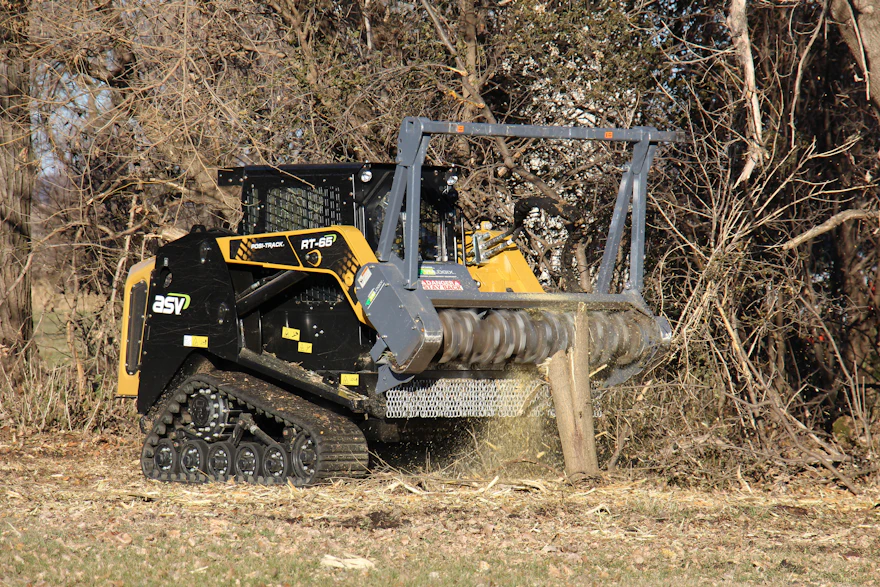 Selecting for Skid Steers and Track Loaders
When it comes to finding the right mulching head for a skid steer or compact track loader, hydraulic horsepower is considerably more important than engine power. To determine hydraulic horsepower, simply multiply the gpm and psi of the power unit's hydraulic system and then divide that number by 1,714. For instance, a track loader with hydraulic ratings of 36 gal per min at 3,450 psi would have a hydraulic horsepower of 72.5 (36 x 3,455 ÷ 1,714). Use that number to ensure the power unit has adequate hydraulics to run the attachment.
Mulching heads are available for a wide range of skid steers, compact track loaders, and even lower flow models. Keep in mind, however, that performance is directly related to hydraulic power. A skid steer with a higher flow can simply outwork one with a lower flow.
Next, it's important to ensure that the skid steer or track loader has the weight capacity to carry it. Also, consider the working conditions. Flotation can be an issue with some power units when a heavy mulching head is used on soft ground. The weight and balance of the unit will make stability another consideration when operating in rough terrain, steep hills, and valleys.
Equipping an Excavator
When it comes to excavators, mulching heads are categorized according to weight class. One series may be designed for excavators weighing from 10,000 to 20,000 lbs., while the next series will work for excavators ranging from 18,000 to 30,000 lbs. It continues to scale up to accommodate the largest excavators on the market.
After identifying the appropriate excavator weight class, the mulching head needs to be configured correctly for the hydraulic output of the power unit. Some mulcher manufacturers offer different hydraulic motor options to handle various flow ratings, while others have different belt drive configurations. For example, the pulley combinations recommended for use on excavators with 15 to 20 gpm hydraulic systems are different than those recommended for 20 to 24 gpm systems. Furthermore, some larger mulching heads may have a piston motor that is adjustable to match the hydraulic output of the power unit.
Weight Class Matching
After identifying the appropriate excavator weight class, the mulching head needs to be configured correctly for the hydraulic output of the power unit.
Mounting Systems
Another factor that makes excavator attachment selection different than skid steers is the lack of a universal mounting system for excavators.
Another factor that makes excavator attachment selection different than skid steers is the lack of a universal mounting system. That means the end user needs to work with the equipment dealer to ensure the appropriate mounting style is installed for the type of excavator being used.
Along with the mounting system, a tilting hitch is a strongly recommended accessory when purchasing a mulching head for an excavator, as it will significantly improve the operating experience. As the name suggests, a tilt hitch allows the operator to tilt the mulching head from left to right. Keep in mind, however, that not all hitches are the same. Some allow the attachment to be pivoted up to 45 degrees either way, while others may have a more restricted range of motion.
Finally, mulching head manufacturers offer a few options unique to excavators. The first is a spade hook, which is helpful for positioning material to be mulched. A hydraulic thumb can also be added for even better use of the spade hook.
Universal Features
Other important considerations apply to both skid steer and excavator mulchers, including the cutting teeth and rotor options. Many mulching heads can be used with either sharpened knives, beaver teeth, or carbide teeth.
Cutting Teeth Options
Knives are quite popular on mulching heads since they are capable of cutting finer and faster than other styles. The downside is that knives require regular sharpening, which is a deterrent to some operators.
Like knives, beaver teeth are made of heat-treated steel, but they do not slice as well. The distinctive pointed shape of beaver teeth helps them pick up material from the ground, despite being less aggressive than knives.
Carbide teeth are a durable, low-maintenance option for less experienced operators. They are often recommended when mulching at ground level in rocky conditions, as they are less prone to damage than knives.
The cutting teeth decision leads to a discussion about the rotor. As sharpened knives have become more popular, so have limiting rotors. Because knives have a natural tendency to bite into material more aggressively than what is ideal, a limiting rotor helps control the material in the feed for more efficient performance. The two main types of limiting rotors available today are ring-style and depth gauges. Ring-style rotors are generally known as having the most restriction. Depth gauges aren't quite as restrictive, which allows operators to pick up material from the ground more easily, especially when using less aggressive carbide teeth.
Using Your Head
When operating this equipment for the first time, one of the most important pieces of advice is to understand the power unit's hydraulic capabilities and then stay within that range. Generally, it's recommended to operate 500 psi underneath the maximum hydraulic relief pressure.
As the load increases, the pressure goes up, and the rotor will slow or even stall when the maximum relief pressure is reached. When this happens, performance is decreased, and heat is generated, which could potentially cause damage to the hydraulic system. To reduce the amount of pressure, operators can simply engage material more slowly.
Pro Tip: Mulching heads can be positioned in various ways to accomplish different tasks. This is why operators should really consider tilt hitches for excavator models. For instance, the head can be tilted back to expose the knives to fell standing trees more efficiently.
When mulching material on the ground, it can be helpful to lower the rear of the cutter. This technique can pin material to the ground, so it doesn't eject out the back of the unit. It can also trap material in the cutting chamber for more thorough processing if desired.
Skid steer operators often use a reverse mulching, or back dragging, technique. Here, the head is tilted forward while the skid steer backs up. This is very effective for sizing material since this action pulls the downed material against the cutter bar and into the chamber. Some units have an adjustable cutter bar to help control particle size and production rate. Some units also have a second cutter bar behind the front bumper, allowing material to be cut twice for more thorough processing. This feature is often referred to as a two-stage cutting chamber.
Like most other things, experience really is the best teacher. Fortunately, there is a lot of demand in right of way vegetation management, forestry, land clearing, and other industries to help newcomers gain meaningful experience with mulching heads. This advice, combined with support from your equipment dealer, will help give you a good head start.
Ready to Get Started?
Explore our selection of professional-grade mulcher attachments designed for skid steers and compact track loaders.
Baumalight MS560 Brush MulcherFinal Thoughts
Selecting the right mulcher attachment requires careful consideration of your power unit's capabilities, the specific terrain and vegetation you'll be working with, and your operational preferences. By taking the time to properly match your equipment and understand the various features available, you'll be well-positioned to achieve efficient, productive results on your land clearing projects. Don't hesitate to reach out to equipment specialists who can provide personalized recommendations based on your specific needs.