


 Damage
  Loss
Loss  Theft
Theft 


What Is a Forestry Mulcher and How Does It Work?
Picture a patch of overgrown land — tangled brush, stubborn stumps, and thick vegetation covering every square foot. Clearing it by hand or with a chainsaw would take days. That's exactly the kind of challenge a forestry mulcher is built to solve.
In this guide, we'll walk through what forestry mulchers are, how they function, their many applications, and what to look for when selecting the right one. Whether you're a landowner tackling a backyard project, a forestry professional managing large tracts, or a farmer looking to reclaim overgrown pasture, understanding these machines can open up new possibilities for managing your property efficiently and sustainably.
What Is a Forestry Mulcher?
A forestry mulcher is a heavy-duty piece of equipment engineered to cut, shred, and grind trees, brush, shrubs, and other organic material. Unlike conventional land-clearing methods — think bulldozers or chainsaws — a forestry mulcher processes everything in a single pass, turning standing vegetation into nutrient-rich mulch that's left on the ground.
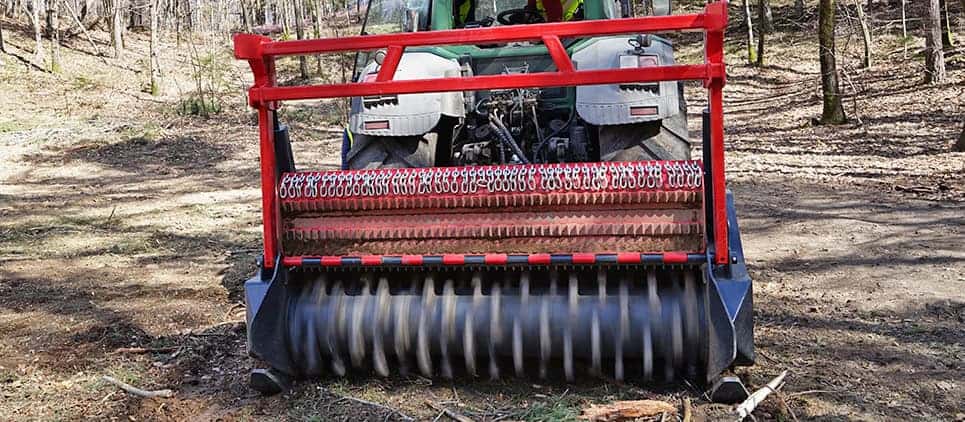
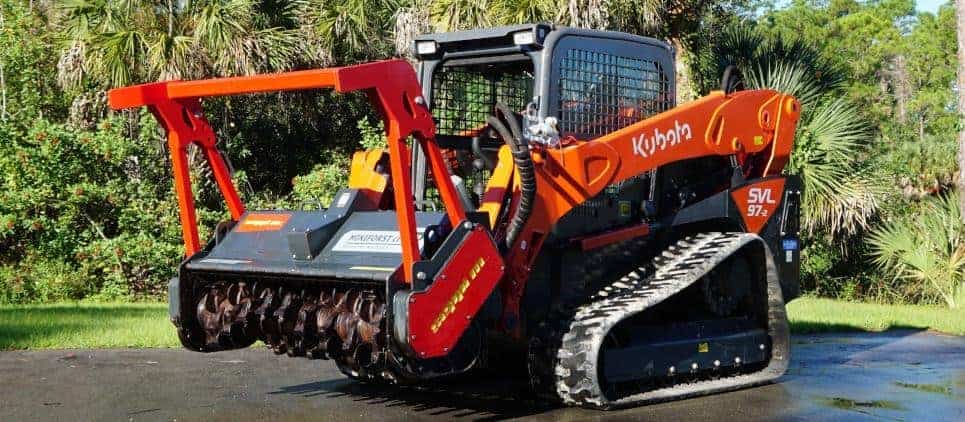
These machines are typically mounted on tractors, excavators, or skid steers. They use a high-speed rotating drum outfitted with steel teeth that shred vegetation into small pieces, depositing it directly on the soil as a natural ground cover. This not only clears the land but also enriches the soil with organic material.
Forestry mulchers come in many sizes and configurations. From large industrial models designed for clearing vast forest tracts to more compact units ideal for residential lots, there's a machine suited for every scale of work.
How Does a Forestry Mulcher Work?
At the heart of every forestry mulcher is a rotating drum fitted with numerous high-strength steel teeth. As the drum spins at high speed, these teeth rapidly chip and shred vegetation into fine mulch. This material is spread evenly over the ground, forming a protective layer that retains moisture and prevents soil erosion.
The performance of a forestry mulcher depends on several key factors: the power of the engine driving it, the tooth design and arrangement, and the rotational speed of the drum. Many models feature adjustable settings, giving operators the ability to customize performance depending on the density and type of vegetation being processed.
Forestry mulchers pair with various host machines — tractors, skid steers, and excavators — to maximize their effectiveness. Mounting a mulcher on a versatile base vehicle allows operators to work across diverse terrain and adapt to a wide range of environmental conditions.
High-Speed Drum
Rotating steel teeth shred vegetation in seconds
Eco-Friendly
Mulch enriches soil naturally without chemicals
Versatile Mounting
Fits tractors, skid steers, and excavators
The Role of Forestry Mulchers in Land Clearing
One of the most impactful uses for a forestry mulcher is land clearing. Whether you're preparing a property for construction, managing conservation land, or simply reclaiming overgrown acreage, these machines deliver a powerful and efficient solution that traditional methods can't match.
Conventional land-clearing approaches — like manual cutting or heavy bulldozing — are time-consuming, labor-intensive, and often destructive to the soil. Forestry mulching, by contrast, leaves the land intact and ready for its next use almost immediately.
Using a forestry mulcher for land clearing means faster project turnaround times and significantly reduced labor costs. The mulch left behind serves as a natural fertilizer, promoting healthier plant growth and eliminating the need for chemical treatments.
This method is also environmentally responsible. It minimizes soil disturbance, prevents erosion, and supports biodiversity by maintaining natural ecosystem processes. A layer of fresh mulch on the ground acts as a living carpet that nurtures the land even as it's being cleared.
Forestry Mulching in Forest Management
Forestry mulchers are invaluable tools in sustainable forest management. By selectively clearing underbrush, dead wood, and overgrown areas, they help maintain the health and balance of forest ecosystems. Well-managed forests are less susceptible to wildfire, more resilient to disease, and better positioned to regenerate naturally.
Wildfire prevention is one of the most critical applications. Forestry professionals use mulchers to create firebreaks and reduce fuel loads — the accumulated dry brush and dead vegetation that can turn a small spark into a devastating blaze. By removing these hazards, mulching reduces the intensity of potential fires and protects both wildlife habitats and nearby communities.
Additionally, forestry mulching supports sustainable logging operations by creating clean access paths and clearing debris from harvest sites. This eliminates the need for burning — a practice that can be difficult to control and carries its own environmental risks.

The Benefits of Forestry Mulching for Agriculture
Agricultural professionals have discovered that forestry mulching brings tremendous advantages to farming operations. By clearing unwanted brush and overgrown areas, farmers can expand their productive acreage and boost crop yields without the expense and disruption of traditional clearing methods.
The mulch left behind plays a vital role in soil health. It retains moisture far more effectively than bare ground, reducing the need for frequent irrigation and conserving water resources. As the organic matter breaks down, it releases essential nutrients back into the soil, fostering stronger and healthier plant growth.
Forestry mulchers are equally valuable for managing pasturelands. By removing invasive species and encouraging the growth of native grasses, farmers can create healthier grazing environments for livestock — a benefit that pays dividends season after season.
Choosing the Right Forestry Mulcher for Your Needs
Selecting the ideal forestry mulcher requires careful consideration of your project's specific demands. Factors like the size of the area you need to clear, the type and density of vegetation, and the terrain will all influence which machine is the best match.
For large-scale commercial operations, a powerful and robust mulcher with a high-horsepower rating is essential. These heavy-duty models can process thick trees and dense brush without slowing down. On the other hand, smaller residential or hobby projects may be better served by a compact, maneuverable unit that's easier to operate and transport.
Compatibility with your existing equipment is another important consideration. Some mulchers are designed to attach directly to specific vehicle types, while others offer more flexible mounting options. Always verify that the mulcher you're considering is compatible with your tractor, skid steer, or excavator before making a purchase.
Maintenance Tips for Your Forestry Mulcher
Keeping your forestry mulcher in top working condition is essential to getting the most out of your investment. Regular maintenance not only extends the machine's lifespan but also ensures peak performance on every job.
Start with the teeth and drum — these components endure the most punishment and should be inspected frequently for signs of wear or damage. Dull or damaged teeth reduce cutting efficiency and put unnecessary strain on the motor.
Keep the drum and all moving parts clean and properly lubricated. Built-up debris and dried sap can impair rotation and lead to mechanical issues over time.
Don't overlook the hydraulic system. Check hoses, fittings, and fluid levels on a regular schedule, following the manufacturer's recommended service intervals. A well-maintained hydraulic system is the backbone of reliable mulcher operation.
Innovations in Forestry Mulching Technology
The world of forestry mulching is evolving rapidly, with new technologies continually raising the bar for what these machines can do. Advances in engine design, tooth engineering, and operator controls have made modern mulchers more powerful, more efficient, and more user-friendly than ever before.
GPS navigation systems are now available on select models, enabling operators to plan and execute clearing projects with pinpoint accuracy. Remote monitoring capabilities allow for real-time performance tracking and diagnostics, reducing downtime and keeping operations running smoothly.
These technological leaps are helping forestry professionals and landowners work more effectively while minimizing their environmental footprint — a win for productivity and for the planet.
The Future of Forestry Mulchers
As the demand for sustainable land management continues to grow, forestry mulchers are poised to play an even larger role in how we care for our land. These machines offer an ideal balance between development and conservation, making them indispensable for modern landowners, contractors, and forestry professionals alike.
Future developments in mulching technology promise greater efficiency and versatility. From autonomous operation to advanced data analytics that optimize clearing strategies, the possibilities are exciting for anyone invested in responsible land stewardship.
Final Thoughts on Forestry Mulchers
Forestry mulchers are reshaping the way we approach land clearing and property management. By offering a sustainable, efficient, and environmentally conscious solution, these machines help landowners and professionals achieve their goals without causing unnecessary harm to the natural world.
If you're considering a forestry mulcher for your next project, selecting the right machine for your specific requirements — and maintaining it properly — will make all the difference. With the right equipment and a solid understanding of how it works, you'll be well-prepared to tackle any land management challenge that comes your way.