


 Damage
  Loss
Loss  Theft
Theft 


The Best 4+ Person Tents for Backpacking
In This Guide
- 4-Person, 3-Season Review Results
- Interior & Shoulder Room
- Packability
- Ease of Setup
- Weather Protection
- Standout Features
- Our Testing Methods
- What Defines a 3-Season, 4-Person Tent?

4-Person, 3-Season Backpacking Tents: Review Results
Interior livability sits at the heart of every buying decision in this class. On paper, the difference between a shelter that feels cramped and one that feels like home can be hard to read from square footage alone — pole geometry, wall angles, and ceiling height all play just as large a role in real comfort. Among the tents we reviewed, only the Big Agnes Copper Spur HV UL 4 felt genuinely roomy for four fully grown adults riding out a storm. The others provided adequate shelter when things turned nasty, but after multiple nights indoors they began to feel confining. For pairs or trios of campers, however, each of these shelters opened up into something close to palatial.
These tents also lean toward the larger end of the backpacking spectrum. The generous fabric area and longer pole sections can test a lone camper's patience, particularly in gusting wind during pitch or takedown. Any of them could happily pull double duty as a car-camping shelter for families or groups wanting extra elbow room on extended outings.
Our Top Pick for Four-Person Comfort
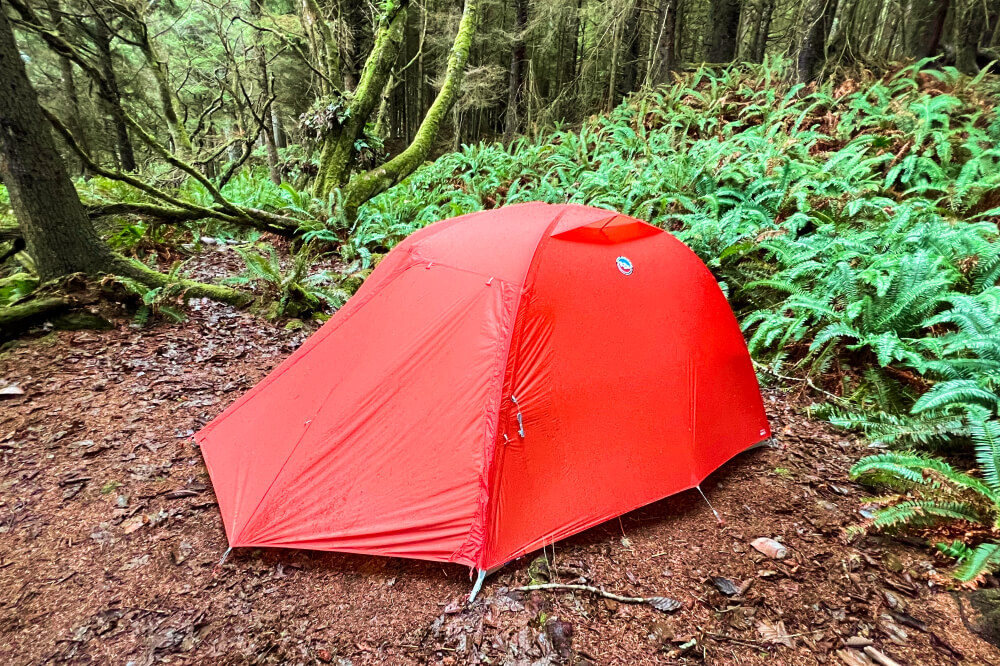
If you're looking for the most livable, weather-tested four-person backpacking shelter we've field-tested, the Big Agnes Copper Spur HV UL 4 stands alone. It's the one tent that truly fit four adults without compromise.
Shop Copper Spur HV UL 4Shoulder Room
The Big Agnes Copper Spur HV UL 4 is the undisputed champion of interior space. The largest floor area, deepest vestibules, highest ceiling, and notably vertical walls combine to create the most livable four-person environment in our test. The taller pole architecture, near-vertical walls, and overall tent geometry didn't offer quite the same compression-resistance as some competitors — but it weathered every three-season condition we threw at it without sustaining damage throughout the testing period.

Packability
When it comes to shrinking down into a loaded pack, the compact, well-engineered backpacking tents we tested have a clear advantage. Much of the win comes down to overall dimensions, but high-quality, thinner fabrics also compress remarkably well. Tents that ship with a generously sized stuff sack make stowing the canopy, fly, and supporting components a quick, low-frustration task.
Set Up
Simple pole architecture wins points here. Designs that rely on two main poles crossing to the corners with a brow pole running through a sleeve produce the most straightforward, repeatable pitches. Testers reported that the most intuitive shelters required no consultation of instructions, even on a first setup. When paired with a competitive price, that kind of simplicity makes these tents shine as entry-level picks for anyone new to backpacking.
Weatherproofing
Weather protection is the single most important metric for any shelter that goes deep into the backcountry. The winning designs in our test combined a taut tent-body pattern, well-engineered pole structure, and a tight-drumming fly that never flapped — even during a desert windstorm that uprooted and folded lesser tents across the campsite. Monsoon-style downpours in the aftermath of a hurricane couldn't breach the best of these shelters either.
A meaningful share of that wind resistance comes from low wall angles and a deliberately modest overall height. The best-performing brands trade some elbow and headroom for fortress-like stability — and on exposed ridgelines, that's the trade you want.
Features
Though interior gear storage can vary widely, some shelters stand out on the strength of a single clever idea. A stargazing fly that lets you sleep under open mesh with the rainfly rolled partway back — and quickly tension it again at the first hint of weather — is the kind of thoughtful design detail that transforms a clear night into an unforgettable one. Welded fly windows that let you peek outside without unzipping a door are another quality-of-life touch worth looking for.
Test Methods
We field-tested these 3-season, 4-person backpacking tents across a wide variety of terrain, weather, and party sizes — from two to four campers. Our shelters traveled through deserts, forests, mountains, and remote backcountry campsites in conditions just short of full winter. Trips ran from single overnights in well-maintained sites to multi-day basecamps deep in remote wilderness.
Interior shoulder room was judged both from the perspective of sheltering four full-sized adults and also from the comfort of fewer campers stretching out. Both long-term and short-term livability were weighed heavily; all tested shelters fit four people in a pinch, but several clearly favored pairs or trios on longer expeditions. Every tent we tested was comfortable for two or three campers across extended outings.
Packability is influenced profoundly by overall size, material quality, and fabric weight. Larger shelters have a natural disadvantage over smaller designs when it comes to pack volume — but there's a wide range of compressibility that can make or break a parties' ability to pack light and fast.
None of the tents tested proved difficult to set up after the first pitch. That said, shelters with longer pole segments or larger built structures can be awkward to manage solo in high wind — something worth keeping in mind.
Every shelter in our test proved weather-resistant across wet-weather conditions, including multi-day monsoon-like storms during the back end of a hurricane. The tents varied in their wind tolerance, however, with only the top-performing design proving truly admirable in the face of near-windstorm gusts. All tents maintained relatively low condensation thanks to the generous mesh panels in their canopies — worth noting, since more mesh can mean chillier interiors when temperatures dip in the shoulder seasons.
What is a 3-Season, 4-Person Backpacking Tent?
The core mission of a 3-season, 4-person backpacking tent is to shelter four people from the conditions typical of spring, summer, and fall — essentially anything short of snow loads and sub-zero temperatures. Some four-person shelters barely accommodate four grown adults head-to-toe, while others offer genuine room for a full party of four to sleep, sit up, and play a round of cards. The trade-off for that extra comfort is almost always weight, packability, and wind resistance.
Brands continue to push the boundary of space-to-weight by leaning on ultralight fabrics and hardware. This represents the lightest class we've tested — and the trend may well continue. But buyer beware: large, ultralight four-person designs often compromise on weather resistance and feature set, both of which can affect comfort as much as interior dimensions in the wrong conditions.
Who It's For
Campers looking for more room and comfort for two or three people (and their pets), or for front-country car-camping outings where the extra floor space is a welcome luxury.
What to Expect
Shelters in this category feel palatial when compared to one- or two-person backpacking tents and are built for longer-term outings. Prices in our research spanned from around $250 to over $650 — our Best In Class winner happened to be the lightest as well.
Many adventurers shopping for a 4-person tent are really after greater comfort for two or three companions. All shelters in this category will feel palatial compared to one-or-two-person designs — and will be much better suited for extended trips. Our testing showed a three-season, four-person field that covers a wide range of cost, weight, materials, weather performance, and comfort.
Ready to Set Up Camp in Style?
The Big Agnes Copper Spur HV UL 4 delivers the roomiest, most weather-ready four-person backpacking experience we've tested — a true benchmark for livability in a lightweight shelter.
Shop Copper Spur HV UL 4