


 Damage
  Loss
Loss  Theft
Theft 


Calculate Pool Heat Pump Sizes
Pool Heating Pump Systems: How To Calculate Heat Loss And Heater Size
Choosing the correct pool heat pump can feel overwhelming, but it doesn't have to be. This guide breaks down the key principles behind pool heat pump sizing so you can make an informed decision. Whether you're a first-time pool owner or a seasoned pro looking to upgrade, understanding how heat pumps work — and how to match them to your pool — will save you time, money, and frustration.
A properly sized pool heat pump calculator takes into account your pool volume, your local climate, desired water temperature, and heat loss factors. The result is a personalized recommendation that ensures your heater performs efficiently without overworking or underperforming.
If you'd like to explore how pool electric heat pumps compare to other heating methods, or if you'd rather connect with a specialist, we encourage you to read on. This article dives a little deeper into the technical side — covering COP ratings, heating formulas, and equipment requirements. Put your thinking cap on, and by the end, you'll feel confident selecting the right heat pump for your backyard oasis.
What Is A COP?
COP stands for Coefficient of Performance, and it's a critical metric for evaluating pool heat pumps as well as air conditioning systems. Traditional resistance heaters typically achieve efficiency ratings around 1:1, meaning every unit of electricity produces one unit of heat. Pool heat pumps, on the other hand, deliver dramatically better results — averaging around a 5:1 return. That means for every 1 kW of electricity consumed, roughly 5 kW of heat is transferred into your pool water.
This impressive efficiency comes from the fact that a heat pump doesn't generate heat from scratch. Instead, it extracts existing thermal energy from the surrounding air and transfers it into the water. Modern inverter-driven models can push COP values as high as 11, depending on humidity and ambient air temperature conditions.
The COP has a direct relationship with ambient temperature and humidity — warmer, more humid environments produce higher efficiency. The higher the COP value, the more powerful the pump is relative to its electricity usage, and the lower your running costs will be.
Example
With a COP of 5, using just 1 kW of electricity consumed, you would create approximately 5 kW of heat released into the pool. That's five times the energy output relative to input — a massive efficiency gain compared to conventional heaters.
For instance, if you want to raise a 40m³ pool by 10 °C with a heating time of 48 hours, you'd need a heat pump with an output of approximately 13.94 kW. Factoring in a COP of 5, the actual power consumption would be around 2.79 kW — keeping your electricity bill surprisingly manageable.
A heat pump should ideally have about 1/5 lower power consumption than its rated heat output. The relationship between the heat delivered to the pool and the power drawn is expressed through this COP factor. The higher the COP, the more economical the system.
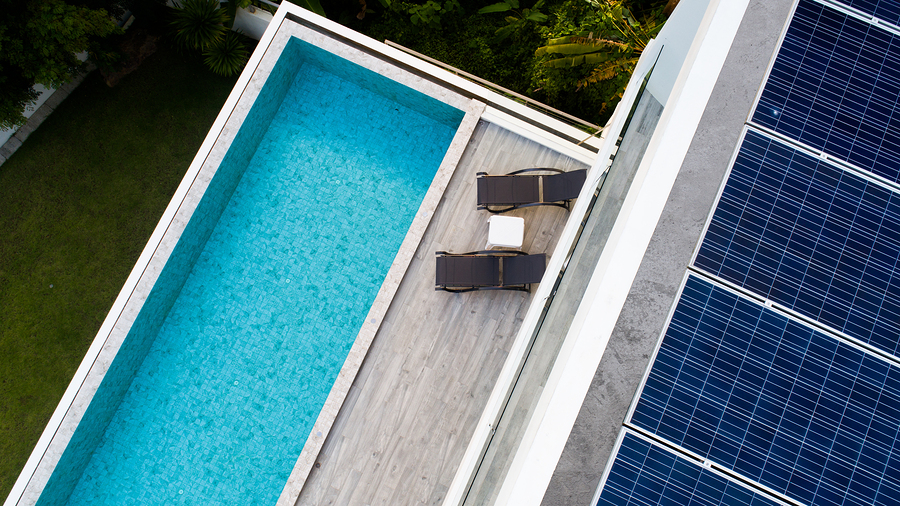
Photovoltaic solar systems are becoming an increasingly popular complement to pool heat pumps. By pairing solar panels with your heat pump, you can offset electricity costs even further — making your pool heating virtually free in sunny conditions.
-min.png?width=445&height=299&name=Reduced%20Size_Fanned_Pool%20Heating%20Evaluation_Madimack%20Pool%20Heating_2022%20(1)-min.png)
How Big Does The Heat Pump For My Pool Have To Be?
If you're running the heat pump through your filtration system, you should typically adjust the kW output to be slightly higher than the calculated minimum. This accounts for heat losses during circulation and ensures consistent temperature maintenance. Here's a general guide based on pool size:
| Pool Size | kW Power Heat Pump |
|---|---|
| 30 – 40 m³ | min 9 kW power |
| 40 – 60 m³ | min 12 kW power |
| 50 – 80 m³ | min 16 kW power |
The heat pump should be able to raise the water temperature by roughly 0.20 – 0.25 degrees per hour. For a standard residential pool — say 10 m³ — that translates to about 1.16 kW to raise the temperature one degree, meaning approximately 11.6 kW for a 10 m³ pool. For larger pools, one kilowatt heats roughly 862 liters of water by one degree Celsius.
The following table shows how the heat pump is best designed based on pool volume and power output:
| Volume (m³) | Temperature Increase Per Hour at a Power of | |||||
|---|---|---|---|---|---|---|
| 8 kW | 12 kW | 18 kW | 25 kW | 36 kW | ||
| 5 | 1.38 | 2.07 | 3.10 | 4.31 | 6.21 | |
| 10 | 0.68 | 0.89 | 1.33 | 1.98 | 2.64 | |
| 20 | 0.28 | 0.45 | 0.65 | 0.98 | 1.31 | |
| 30 | 0.21 | 0.28 | 0.45 | 0.67 | 0.89 | |
| 40 | 0.16 | 0.23 | 0.34 | 0.48 | 0.67 | |
| 50 | 0.13 | 0.19 | 0.27 | 0.38 | 0.54 | |
| 60 | 0.11 | 0.15 | 0.21 | 0.33 | 0.45 | |
| 70 | 0.08 | 0.13 | 0.19 | 0.28 | 0.38 | |
| 80 | 0.07 | 0.11 | 0.16 | 0.25 | 0.33 | |
| 90 | 0.07 | 0.10 | 0.15 | 0.22 | 0.29 | |
| 100 | 0.06 | 0.09 | 0.13 | 0.20 | 0.26 | |
| 120 | 0.05 | 0.07 | 0.11 | 0.16 | 0.22 | |
Choosing The Right Pool Heat Pump For Your Pool Size
The performance data above is based on the following calculation basis:
P = C x V x (T2 – T1) / h
P = Performance of swimming pool heat pump
C = Heat storage coefficient of water = 1.16
V = Pool volume
T2 = Set temperature (desired)
T1 = Start temperature (current)
h = Heat-up time
The maximum heating time should be 4 hours per 1 °C water temperature change. This is calculated based on the heat loss during the night being up to 2 °C, meaning it would take 8 hours to reach full temperature — keeping a constant warmth throughout the swimming season.
Worked Example
Suppose you own a swimming pool with 40 m³ of water and an initial temperature of 18 °C. You want to bring it up to 28 °C. The maximum heating time should be 4 hours per 1 °C increase. Therefore, it takes 40 hours to heat your 40 m³ pool by 10 °C.
Applying the formula:
P = 1.16 x 40 x (28 – 18) / 40 = 11.53 kW
What Else Do You Need To Know About A Heat Pump?
Where you place your heat pump matters just as much as choosing the right size. Heat pumps need a steady flow of fresh ambient air to function properly, so they should be installed in a well-ventilated outdoor location. Indoor setups rarely produce the same results because airflow is restricted.
The unit itself is plumbed directly into your existing filtration circuit, typically positioned after the filter system and before the water returns to the pool. This ensures the cleanest possible water flows through the heat exchanger, extending the life of the unit.
Modern, high-quality pool heat pumps feature corrosion-protected heat exchangers and are compatible with virtually all types of pool water treatment systems — including chlorine, bromine, ozone, and chlorine-free alternatives. They also serve as an excellent complement to gas heaters or electric resistance heaters, helping to reduce ongoing costs while maintaining optimal pool temperatures. Whether you're heating a saltwater pool or a traditionally treated one, a heat pump can enhance your pool's energy efficiency, reduce your heating bills, and shorten the time it takes to reach your desired temperature.
Pairing your heat pump with a pool solar cover is a game-changer for efficiency. A quality cover reduces evaporation — the number one source of heat loss — and can cut your heating time substantially. This simple addition makes a heat pump a viable choice for virtually any type of pool.
Keep in mind that factors like solar gain, wind exposure, and evaporation rates all play a role in heat loss calculations. This article aims to give you a solid foundation for understanding pool heat pump sizing — the rest comes down to choosing the right product for your specific backyard setup.
Featured Product
Ready to Heat Your Pool Efficiently?
Explore our energy-saving pool heat pump — built for pools up to 25,000 gallons with 110,000 BTU of heating power.
Blue Torrent Pool Heat Pump 110K BTU