


 Damage
  Loss
Loss  Theft
Theft 


What Size Pool Heater Do I Need For My Pool?
 What "Pool Heater Size" Really Refers To
Pool heater size is expressed in BTUs, short for British Thermal Units. A single BTU is the amount of energy it takes to raise one pound of water by one degree Fahrenheit.
The higher the BTU rating, the more heat the unit puts out per hour, and the faster your pool reaches its target temperature. A higher BTU rating does not mean the heater is only meant for large pools. A high-BTU heater paired with a smaller pool simply heats it faster and cycles off sooner.
Standard residential BTU sizes generally land at 100K, 150K, 200K, 250K, 300K, and 400K BTU.
Why Surface Area Beats Gallons
Most homeowners reach for gallons first. That's the wrong place to start.
Roughly 70% of pool heat loss happens at the surface through evaporation, not through the walls or floor. That's why two pools with identical volumes can call for very different heaters when one has a larger surface footprint.
Picture a 15,000-gallon pool measuring 14 by 28 feet (392 sq ft). It loses heat noticeably slower than another 15,000-gallon pool that measures 16 by 32 feet (512 sq ft). Same water volume. Different surface. Different BTU requirement.
One exception: if you're sizing a heater for a spa or hot tub, volume matters more than surface area. Hot tubs generally operate at warmer temperatures, and a larger heater helps them reach that target faster.
How to Calculate the Right Pool Heater Size
You have two solid options here. A quick formula to get a ballpark figure, and a more precise one when you want to account for real-world conditions.
The Simple Formula
Take your pool's surface area, divide it by 3, and multiply by 1,000 to land on a minimum BTU rating. This baseline typically supports a 25 to 30 degree Fahrenheit temperature rise.
The Precision Formula
BTUs needed = pool surface area × temperature rise × 12. The multiplier of 12 accounts for typical evaporation and convection losses under average wind conditions.
The Volume Cross-Check
Use this as a sanity check against your surface area number. Plan on 50,000 BTUs per 10,000 gallons in mild climates, and 100,000 BTUs per 10,000 gallons in cool climates.
Take a 15x30 ft pool (450 sq ft) that needs to climb from 65 to 82 degrees, a 17-degree rise: 450 × 17 × 12 = 91,800 BTUs per hour just to hold temperature. To actually warm that pool from 65 to 82 within 24 hours or less, you'll want a heater closer to 250,000 to 300,000 BTUs.
Recommended Heat Pump for Mid-Size Pools
The Blue Torrent CFT 65 delivers 65,000 BTU of consistent, energy-efficient heating, designed for pools up to 13,000 gallons. A reliable pick when you want quiet operation and steady performance through the swim season.
Shop Blue Torrent CFT 65Pool Heater Size by Pool Size and Climate
The chart below covers the most common residential pool dimensions. Use it as a starting reference, then adjust based on the factors covered in the next section.
| Pool Size | Approx. Gallons | Mild Climate | Cool Climate |
|---|---|---|---|
| 12 x 24 ft | ~7,500 gal | 100K-150K BTU | 200K BTU |
| 15 x 30 ft | ~11,000 gal | 150K BTU | 250K-300K BTU |
| 16 x 32 ft | ~15,000 gal | 150K-200K BTU | 300K-400K BTU |
| 20 x 40 ft | ~24,000 gal | 200K-250K BTU | 400K BTU |
| 25 x 50 ft | ~30,000+ gal | 300K BTU | 400K+ BTU |
Mild climate refers to regions with average air temperatures in the high 60s and 70s for most of the swim season, like Florida, Southern California, or the Texas Gulf coast. Cool climate covers the Northeast, Pacific Northwest, Mountain West, and most of the Midwest, where evenings frequently drop into the 50s and 60s.
Five Factors That Shift Your Final Pick
1. Pool Cover Usage
A solar or thermal pool cover dramatically cuts evaporative heat loss. If you use a cover consistently overnight, you can often size down by one BTU tier without sacrificing comfort. If you never cover the pool, plan for the upper end of the range.
2. Local Wind Exposure
Wind accelerates evaporation, and evaporation drains heat. Pools in open, exposed yards or near coastlines need more BTUs than those tucked behind fences, hedges, or screens. This is where the precision formula's higher multiplier (14 to 16) earns its keep.
3. Desired Temperature Rise
A heater sized for an 8-degree rise is very different from one tasked with a 25-degree rise. Be honest about your target. Most swimmers find 80 to 84 degrees ideal, so calculate your rise from your typical ambient water temperature.
4. Sunlight Exposure
Pools that bake in direct sun get a meaningful free assist from solar gain. Pools shaded by trees, structures, or northern orientation lose that bonus and require more heater output to keep up.
5. Heater Type
Gas heaters deliver the highest BTU output and heat fast, but cost more per hour to run. Heat pumps run more efficiently and quietly, though they need warmer ambient air (above 50°F) to operate at their rated output. For most homeowners extending the swim season, a properly sized heat pump strikes the best balance between performance, energy costs, and longevity.
Final Thoughts
Getting the size right comes down to running the numbers, not guessing. Start with surface area, run both formulas, cross-check against the volume table, then adjust for your specific conditions. A correctly sized heater warms your pool to the temperature you want, on the schedule you want, without overworking the unit or your wallet. When in doubt, lean slightly toward more BTU rather than less. A larger heater simply cycles off sooner. An undersized heater never catches up.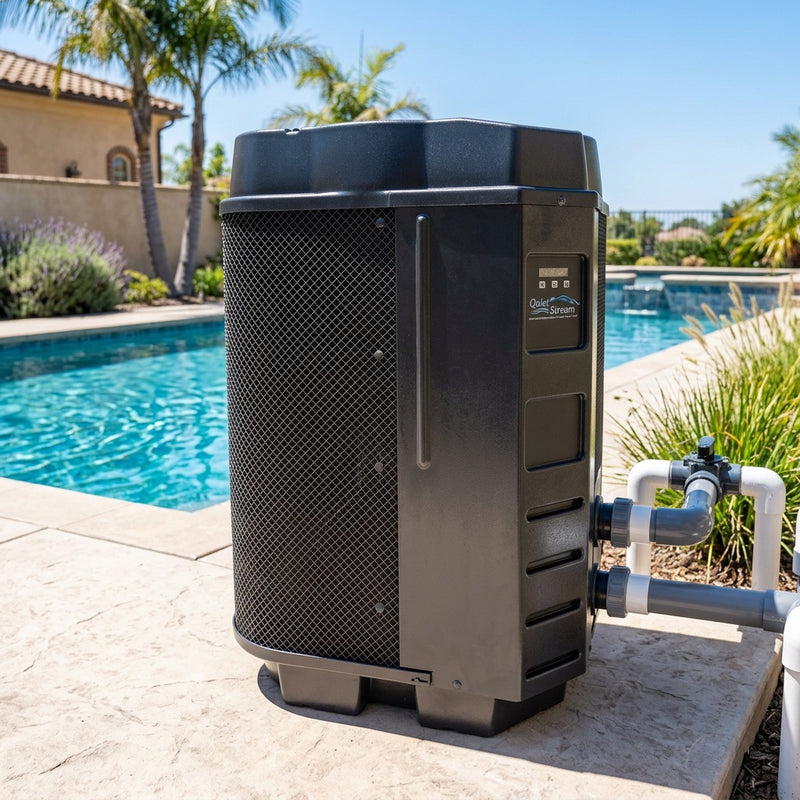
Ready to Heat Your Pool?
The Blue Torrent CFT 65 Pool Heat Pump pairs 65,000 BTU of output with the efficiency of modern heat pump technology, sized perfectly for pools up to 13,000 gallons. A quiet, dependable choice for a longer swim season.
Shop Blue Torrent CFT 65