


 Damage
  Loss
Loss  Theft
Theft 


How to Perfectly Size Your Solar Inverter for Maximum Power Output
In This Guide
1. Why Solar Panel Inverter Size Matters for Your System
2. Oversized vs. Undersized: How Wrong Inverter Capacity Destroys Efficiency
3. Solar Inverter Sizing: The 1:1.15 Ratio Rule Explained
4. Choosing the Right Solar Power Inverter for Different System Types
5. How to Size Your Solar Inverter for Future Panel Expansion
6. Get Your Solar Inverter Right the First Time
7. 7 FAQs About Solar Panel Inverter Sizing
You've spent thousands on solar panels, selected a solid battery system, and you're eager to start harnessing your own electricity — but hold on, are you confident your solar panel inverter is the correct size? Far too many homeowners guess at this crucial step or blindly rely on whatever ships with their solar panel kit, only to realize months later their system is dramatically underperforming. The reality is that properly matching your inverter to your panel array's output is one of the simplest ways to increase efficiency by 20% or more — and the entire calculation takes just five minutes.
Why Solar Panel Inverter Size Matters for Your System
Your solar panel inverter is responsible for converting the DC electricity generated by your panels into usable AC power for your home's appliances and electronics. Choosing the correct size determines whether your system operates at 95% efficiency or a disappointing 70% — a gap that translates into hundreds of dollars in wasted energy production annually.
✓ Every inverter carries a capacity rating measured in watts or kilowatts, indicating the maximum amount of power it can process at any given moment.
✓ Your panels may produce abundant electricity, but if the inverter cannot handle the full volume, that surplus power is simply wasted — no amount of premium panel technology can compensate for an undersized inverter.
✓ Residential solar inverters generally range from 3kW to 10kW depending on system scale, while RV setups typically use compact 1–2kW units built for mobile applications.
✓ String inverters process the entire array's output collectively and must be matched to total wattage. Microinverters operate on individual panels for finer optimization. Hybrid inverters manage both solar generation and battery charging — each type demands its own capacity calculation approach.
Oversized vs. Undersized: How Wrong Inverter Capacity Destroys Efficiency
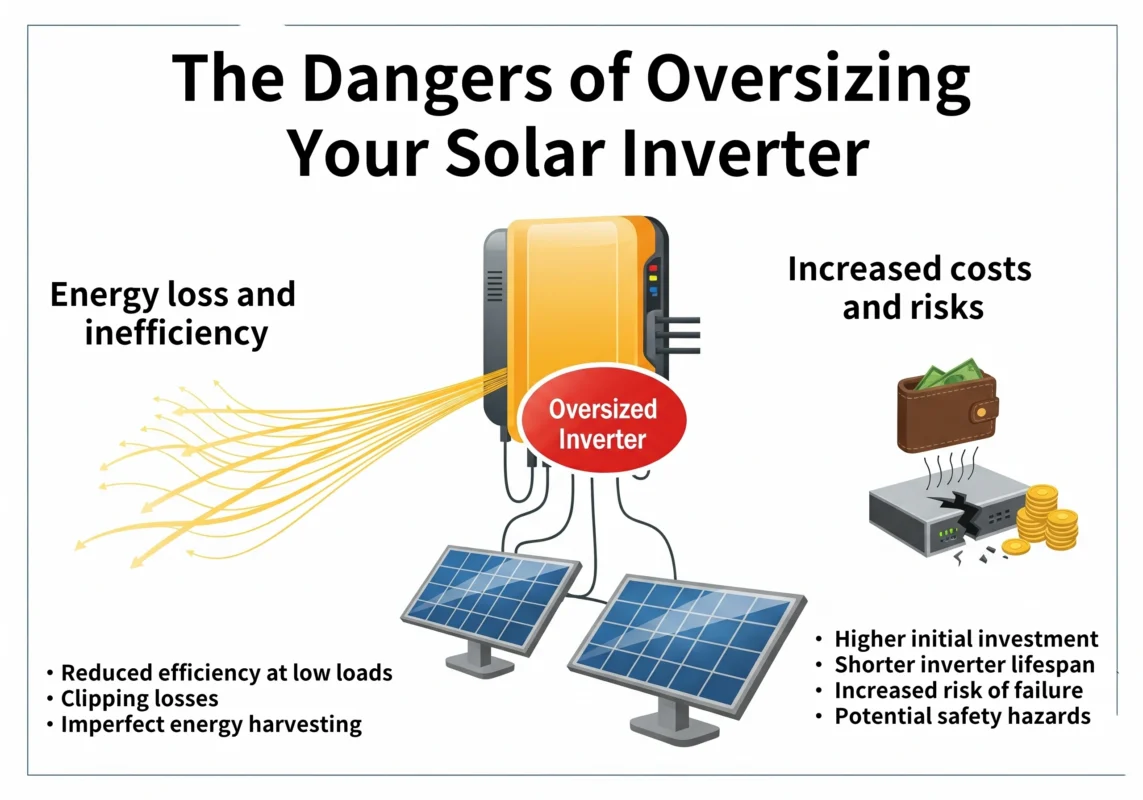
Selecting the wrong inverter capacity for your solar panel system can seriously damage both your wallet and your equipment. Here is exactly what goes wrong when your inverter fails to match your array's output.
Oversized Inverter Problems
1. Reduced Efficiency at Low Loads
Inverters deliver their best performance at 80–95% of rated capacity. An oversized unit spends most daylight hours running at just 40–60% load, where conversion efficiency drops noticeably. Pairing a 5kW inverter with a 3kW array, for example, leads to elevated standby consumption and unnecessary conversion losses throughout the day.
2. Money Wasted on Idle Capacity
Larger inverters carry price tags hundreds or even thousands of dollars higher. When that oversized residential inverter sits underutilized year after year, you are effectively paying for capacity that never gets tapped — extending your payback period and eroding your return on investment.
3. Phantom Power Drain
Even after dark when panels stop producing, an oversized inverter quietly draws 10–30 watts just to keep its internal systems alive. Across months and years, that amounts to real electricity pulled from your grid or battery bank — costing you money with absolutely zero benefit in return.
Undersized Inverter Problems
1. Energy Lost to Clipping
When panels generate more power than the inverter can process, the surplus is "clipped" — discarded entirely. On a clear day when a 6kW array reaches full output but the 4kW inverter hits its ceiling, 2kW of electricity you already invested in simply vanishes.
2. Shortened Equipment Life
An undersized inverter that constantly operates at peak capacity produces excessive heat and places relentless stress on its internal components. This can slash the typical 10–15 year lifespan down to just 7–10 years, forcing a premature and costly replacement.
3. Protective Safety Shutdowns
When overloaded beyond its limits, built-in safety mechanisms shut the entire system down to prevent hardware damage. These shutdowns during your best sun hours waste valuable production time and create wear from constant power cycling — sometimes even triggering utility disconnects that demand a manual reset.
Solar Inverter Sizing: The 1:1.15 Ratio Rule Explained
Most solar professionals suggest sizing your inverter between 75% and 115% of your total panel wattage, with the ideal sweet spot sitting around a 1:1.15 ratio — meaning your inverter is rated slightly below your array's total capacity. While this may seem counterintuitive, your panels seldom reach their maximum rated output due to weather fluctuations, temperature changes, and seasonal variation. A slightly smaller inverter spends more of the day operating in its peak efficiency zone, and you avoid paying for capacity that goes largely unused.
5-Step Formula to Calculate Your Ideal Inverter Size
Total Up Your Panel Wattage
Count every solar panel in your array and multiply by the individual wattage rating. For instance, twenty 400-watt panels give you a combined 8,000 watts (8kW).
Account for Location and Sun Hours
Sun-drenched regions like Arizona can confidently apply the full 1:1.15 ratio, while cloudier locations like Seattle may benefit from a tighter 1:1 or 1:0.9 ratio since panels will rarely reach peak output.
Subtract Real-World System Losses
Actual systems lose 10–25% of power through wiring resistance, heat buildup, shading, and surface dirt. Multiply your total panel wattage by 0.80 to account for a standard 20% loss — that 8kW array realistically delivers about 6.4kW.
Apply the Sizing Ratio
Take your loss-adjusted wattage and divide by 1.15 to find the minimum inverter size. Using our example: 6.4kW ÷ 1.15 = 5.6kW minimum.
Match to Standard Inverter Sizes
Inverters ship in standard ratings such as 3kW, 5kW, 6kW, 8kW, and 10kW. Round to the nearest available size — in our example, a 5.5kW or 6kW residential inverter is the ideal fit.
Inverter Sizing Examples for Home and RV Solar Systems
Home Rooftop System
A standard 4kW residential array with ten 400W panels pairs best with a 3.5kW to 4kW inverter. After factoring in 20% real-world losses, panels deliver roughly 3.2kW under typical conditions, so a 3.5kW inverter runs at about 91% capacity during peak hours — landing right in the efficiency sweet spot.
RV Solar Setup
A well-matched RV solar kit typically pairs 1,200–2,400 watts of panels with a 1,000–2,000 watt inverter. A popular configuration uses four 300W panels (1,200W total) alongside a 1,000W inverter — sufficient for lights, fans, phone chargers, and a compact refrigerator without adding unnecessary weight or cost.
Complete Off-Grid Kit
When purchasing a complete solar kit with battery and inverter, the inverter must accommodate both panel input and battery charging demands. A 3kW kit usually includes a 2.5–3kW hybrid inverter capable of processing solar power while simultaneously charging batteries and powering household loads — these units often feature higher surge capacity (5–6kW) to handle motor startups from appliances like well pumps or power tools.
Quick Sizing Formula
(Total Panel Watts × 0.80 for losses) ÷ 1.15 = Minimum Inverter Size
Example: (6,000W × 0.80) ÷ 1.15 = 4,174W — Choose a 4kW or 4.5kW inverter
Choosing the Right Solar Power Inverter for Different System Types
Your inverter requirements shift considerably depending on whether you are connected to the utility grid, living fully off-grid, or powering a recreational vehicle. Here is how to match your solar power inverter to your specific configuration.
Grid-Tied vs. Off-Grid: How Your Connection Shapes Inverter Size
| System Type | Sizing Approach | Typical Capacity | Why It Works |
|---|---|---|---|
| Grid-Tied | Size for average usage | 3–5kW for most homes | Grid fills gaps during load spikes |
| Off-Grid | Size for peak loads + charging | 30–50% larger (7–8kW+) | No grid backup — inverter handles everything |
Grid-tied systems can get away with smaller inverters because the utility grid acts as your safety net. If a sudden spike occurs — say your air conditioner and oven kick on simultaneously — the grid automatically supplements the difference. This allows you to size for typical daily usage rather than worst-case scenarios, saving hundreds on equipment.
Off-grid systems need inverters sized for absolute peak loads plus simultaneous battery charging, since there is no external backup. Running a well pump (1,500W), refrigerator (600W), and lighting (300W) while charging batteries means your inverter must handle all of it at once — typically demanding 30–50% more capacity than a comparable grid-tied home.
What to Know About Solar Panel Kits with Battery and Inverter
Hybrid systems that bundle batteries introduce additional complexity to inverter sizing. Here are the most important factors to consider:
Hybrid inverters juggle three tasks at once: converting solar DC to AC power, charging the battery bank, and supplying electricity to your home. You need sufficient capacity to handle peak household demand plus the battery charging rate — if you want to charge a 5kWh battery in 2–3 hours while running 2kW of appliances, you need at least a 4–5kW hybrid inverter.
Match inverter capacity to battery charge rates, not just panels: Most lithium batteries accept 0.5C to 1C charging rates (a 5kWh battery charges safely at 2.5–5kW). Even if your panels only produce 3kW today, choose an inverter that accommodates future battery or panel upgrades.
Surge capacity is critical for motors and compressors: Refrigerators, freezers, air conditioners, and power tools draw 2–3 times their running wattage during startup. Your inverter should offer surge capacity rated at least double its continuous rating — a 3kW continuous inverter typically provides 6kW surge for 5–10 seconds, enough to start most household appliances.
RV Solar Systems: Balancing Power with Portability
| Component | Typical Size | Weight | Power Output |
|---|---|---|---|
| Solar Panels | 1,200–2,000W (4–6 panels) | 40–60 lbs | Covers lights, electronics, refrigerator |
| Inverter | 1,000–2,000W pure sine | 15–25 lbs | Handles most loads except large AC |
| Battery | 200–400Ah lithium | 60–120 lbs | 2–4 days of typical usage |
The best RV solar kit strikes a careful balance between energy needs and physical constraints. Most systems perform well with 1,200–2,000W of panels and a 1,000–2,000W inverter, comfortably handling LED lighting (100W), laptops (65W), phone chargers (20W), a 12V refrigerator (50W average), and fans (30W each) with headroom to spare.
Space and weight are your true limiting factors: rooftop area restricts how many panels you can mount, and every additional pound matters against your vehicle's gross weight rating. A complete 1,500W system with inverter, 200Ah lithium battery, and mounting hardware tips the scales at 150–200 pounds total — manageable for most RVs but worth confirming before installation.

RV air conditioners represent the biggest challenge: they draw 2,000–3,000W at startup despite running at only 1,200–1,500W. If air conditioning from solar is a priority, your kit needs at minimum a 3,000W inverter with 6,000W surge capacity. Many RV owners opt for smaller 1,000–1,500W systems and forgo the AC, relying on solar for everything except the most power-hungry appliance onboard.
How to Size Your Solar Inverter for Future Panel Expansion
Most homeowners add more panels within 3–5 years once the savings become obvious and the desire to electrify more of the home kicks in. Planning your inverter purchase with future growth in mind can save thousands and prevent replacing equipment you just installed.
The Smart Way to Size for Growth
If expanding your system later is even a possibility, add 10–25% extra inverter capacity from the start. Here is how to think about it:
Current system: 5kW of panels
Potential future system: 6–6.5kW with added panels
Inverter to buy now: 6–7kW instead of 5kW
This buffer costs an additional $200–500 upfront but saves $1,500–3,000 on full inverter replacement down the road. Be honest about your available roof space — if your roof accommodates 8kW total but you are starting with 5kW, that 7–8kW inverter makes financial sense from day one.
Three Situations Where Oversizing Makes Perfect Sense
You Have Firm Expansion Plans Within 1–2 Years
Adding an electric vehicle, heat pump, or home addition soon? Purchase the larger inverter now. The price gap between a 7kW and 10kW unit ($400–800) is far less than the cost of replacing a 7kW inverter later ($2,000–3,000 including labor).
Your Roof Is Maxed Out But Your Budget Isn't
When your roof supports 8kW but you can only afford 5kW of panels today, install the 8kW inverter immediately. You will add those remaining panels sooner than you think, and inverter prices will not drop enough to justify waiting.
Battery Storage Is in Your Future
Planning to integrate batteries within the next few years? Choose a hybrid inverter sized for both your eventual panel array and battery charging needs today, even if it appears oversized for your current panels alone.
⚠ The True Cost of Upgrading Later
Replacing an inverter means paying for the new unit, disposing of the old one, and 6–8 hours of electrician labor at $100–150 per hour. That initial $600 "savings" on a smaller inverter can quickly become a $2,800 mistake within a few years. This is precisely why many homeowners with serious expansion plans invest in whole-home energy storage systems from the outset — a powerful inverter that accommodates everything from a starter battery setup to a fully expanded system without ever requiring replacement or secondary units.

Get Your Solar Inverter Right the First Time
Matching your inverter to your solar panels at the 1:1.15 ratio is the simplest and most reliable method to maximize efficiency and safeguard your investment. A correctly sized inverter means capturing 95% of the energy your panels produce rather than losing hundreds of dollars each year to clipping or poor conversion rates.
Take 10 minutes to add up your total panel wattage, factor in 20% for real-world system losses, and divide by 1.15 to find your ideal inverter capacity. If you are uncertain about the specifics of your setup or have expansion on the horizon, consult with a licensed solar installer who can evaluate your roof area, electrical panel capacity, and long-term goals — getting the sizing right the first time saves thousands in replacement costs down the line.
7 FAQs About Solar Panel Inverter Sizing
Q1: What size solar panel inverter do I need for a 5kW system?
For a 5kW panel array, an inverter in the 4.3kW to 5kW range delivers optimal efficiency. Applying the formula — (5,000W × 0.80) ÷ 1.15 — gives a minimum of approximately 3,478W, but most professionals recommend a 4–5kW inverter to balance efficiency with real-world system losses. In practice, a 5kW inverter pairs perfectly with a 5kW array.
Q2: Can I use a smaller inverter than my solar panel capacity?
Absolutely — in fact, it is often the recommended approach. Choosing an inverter that is 10–15% below your total panel capacity keeps it operating more consistently in the ideal 80–95% efficiency range. Weather and temperature rarely allow panels to run at full rated output, so a slightly undersized inverter is the smarter match. For example, a 5–5.5kW inverter pairs beautifully with a 6kW panel array.
Q3: What happens if my inverter is too small for my solar panels?
When an undersized inverter reaches its capacity ceiling, "power clipping" occurs — the excess electricity your panels produce during peak hours is simply discarded. If a 6kW array hits full output but your 4kW inverter is maxed out, 2kW of already-paid-for electricity disappears. Beyond lost energy, this also stresses the inverter through constant full-capacity operation, potentially cutting its 10–15 year lifespan down to 7–10 years.
Q4: What is included in a solar panel kit with battery and inverter?
A complete kit typically contains solar panels, a hybrid inverter/charger that manages both solar conversion and battery charging, a battery bank (usually lithium), a charge controller (sometimes built into the inverter), mounting hardware, wiring, and basic installation instructions. Most residential kits range from 3kW to 10kW in total capacity.
Q5: Should I oversize my inverter for future solar panel expansion?
If additional panels are in your 3–5 year plan, oversizing by 10–25% is a wise investment. Starting with a 5kW system that may grow to 6.5kW? Purchase a 6–7kW inverter now. The extra $200–500 upfront saves $1,500–3,000 in future replacement costs. However, if you have no concrete expansion plans and limited roof space, oversizing wastes money on capacity that will never see use.
Q6: How long do solar panel inverters last?
String inverters typically last 10–15 years, while microinverters often carry warranties extending to 25 years. Operating temperature plays a major role in lifespan — units installed in cool, shaded, well-ventilated locations significantly outlast those mounted in hot attics or direct sunlight. Over your solar panels' 25–30 year lifespan, budget for at least one inverter replacement.
Q7: Do I need a special inverter for a solar panel kit with battery storage?
Yes — you need a hybrid inverter (also called a battery inverter or inverter/charger) capable of managing both solar input and battery charging simultaneously. Standard grid-tied inverters cannot charge batteries. Hybrid inverters cost 20–40% more than standard models but handle solar power conversion, battery charging, load management, and often provide backup power during outages — all essential functions for any battery-integrated system.
Ready to Power Your Backyard the Right Way?
Explore our selection of inverters, solar kits, and off-grid power solutions.
BLUETTI AC300 3,000W Inverter Module