


 Damage
  Loss
Loss  Theft
Theft 


How to Choose the Best Basketball Hoop for Your Space
Whether you're outfitting a driveway, a gym, or a full backyard court — this guide covers everything you need to make the right call.
Choosing a basketball hoop isn't just about picking the tallest pole or the biggest backboard. The right setup depends on where you'll install it, who will use it, and how seriously you play. This guide walks you through every major decision point — from hoop type and location to backboard material, rim style, and standard height guidelines — so you end up with a system you'll love for years.
What We'll Cover
- Hoop Location: Configure Your Court
- What Basketball Hoop Is Best as a Driveway?
- Is There a Portable Hoop That's One Piece for You?
- Backboard Sizing
- Backboard Material
- Summary
- Tempered Glass
- How to Choose a Shorter Basketball Hoop
- The Standard Height: 10 Feet
- How to Choose a Basketball Hoop for Kids
- Adjustable Basketball Hoops
- The Importance of Consistency
Hoop Location: Configure Your Court
The single most important factor in choosing your hoop is where it's going to live. Your location determines which hoop types are even viable, how much space you have for play, and what kind of installation makes sense. There are four primary court configurations to consider.

Once you've identified your location, think about surrounding clearance. You want a minimum of several feet of unobstructed space behind the baseline and on both sides of the lane. A cramped court leads to awkward play and safety risks — especially with younger players or aggressive games.
Backboard Overhang
Pay close attention to the offset distance — how far the backboard extends out from the pole. A greater offset moves the playing area away from the pole and any obstacles behind it, giving players more room to drive the lane without running into the support structure. Most quality in-ground systems offer an offset between 3 and 4 feet. The more generous the offset, the better the play experience in tight spaces.
Pool
If you're installing near a pool or water feature, take extra care with your location choice. Positioning the hoop beside the pool rather than directly over it keeps the playing surface dry and safe, and prevents water damage to your system over time. Look for hoops with corrosion-resistant hardware if moisture exposure is a concern in your setup.
What Basketball Hoop Is Best as a Driveway?
For most homeowners, the driveway is the default court. It's flat, paved, and already there. The good news: almost every hoop type works on a driveway. The decision comes down to whether you want something permanent or moveable.
In-Ground Hoops
Set in concrete, these systems are the most stable option available. They eliminate pole wobble entirely and give you a true court-quality feel. Best for players who are serious about their game and don't plan to move the hoop.
Portable Hoops
Mounted to a weighted base, portable hoops can be repositioned as needed. Modern portable systems have improved significantly — a heavy, water-filled base with a quality pole can approach in-ground stability. Best for renters or families who want flexibility.
Is There a Portable Hoop That's the One Piece for You?
Portable hoops have come a long way. Today's best systems offer regulation-size backboards, spring-loaded rims, and heavy-duty bases that rival the stability of entry-level in-ground models. They're also far easier to set up — most can be assembled by two people in an afternoon without any concrete or excavation work.
What to Look for in a Portable Hoop
- A wide, heavy base — ideally fillable with both sand and water for maximum weight
- A telescoping or crank-adjusted pole for simple height changes
- A backboard of at least 54" for a realistic rebounding experience
- A spring-loaded rim to handle dunks and hard play without damage
- Wheels built into the base for easy relocation without tipping
- UV-resistant materials to prevent cracking and fading outdoors

Backboard Sizing
Backboard size has a direct impact on how your game feels. A larger board gives you more surface area for bank shots, more accurate rebounding, and a more genuine court-like experience. Here's how the sizing breaks down across different use cases:
| Backboard Size | Best For | Space Needed |
|---|---|---|
| 44" – 48" | Young children, small driveways, recreational play | Minimal — suits tight spaces |
| 50" – 54" | Teens, casual family games, moderate driveways | Standard residential driveway |
| 60" | Competitive players, serious backyard courts | Generous driveway or dedicated court |
| 72" | Regulation play, skill development, maximum authenticity | Full court or wide open driveway |
The 72" board is the regulation NBA size — if you're training to compete or simply want the most authentic experience your backyard can offer, this is the standard to aim for.
Backboard Material
The material of your backboard affects ball response, durability, and overall play quality. There are three primary options across today's basketball hoop market.
Polycarbonate
The entry-level choice. Durable and impact-resistant, polycarbonate boards handle outdoor conditions well but deliver a noticeably softer, less consistent ball response. Fine for recreational play — not ideal for serious skill development.
Acrylic
A meaningful step up. Acrylic offers better transparency and improved ball response over polycarbonate. It's a popular choice for mid-range systems — good enough for competitive family play without the premium price of glass.
Summary
When it comes to backboard material, the hierarchy is clear: polycarbonate for casual use, acrylic for everyday competitive play, and tempered glass for anyone who takes the game seriously. The upgrade in ball response between each tier is genuinely noticeable — especially when practicing off the glass.
Tempered Glass
Tempered glass is the professional standard — used in every NBA arena and every serious training facility in the world. It delivers the truest, most consistent ball response of any backboard material, making bank shots feel the way they're supposed to and giving players instant, reliable feedback on every shot.
Why Serious Players Choose Glass
- Identical ball response to what you see in the pros — no surprises off the glass
- Crystal-clear visibility that won't yellow or cloud over time outdoors
- Significantly heavier and more rigid — reduces backboard flex on hard contact
- The premium option for any player focused on real skill development
- Pairs best with a heavy-duty in-ground system for maximum stability
How to Choose a Shorter Basketball Hoop
Not every player is ready for a 10-foot rim. Younger children develop better mechanics, more confidence, and a genuine love for the game when they start at a height that suits their age and size. A hoop set too high turns every shot into a heave — and that builds bad habits fast.
When shopping for a shorter hoop for younger players, look for systems with easy height adjustment so the rim can grow with the child over time. A hoop that starts at 6 feet and adjusts up to 10 feet is far more versatile than a fixed-height system — and it means you won't need to replace the unit every couple of years.
- Look for smooth, tool-free height adjustment — crank systems are ideal for kids
- Choose a stable base that won't tip when smaller players reach up for the rim
- A smaller backboard (44"–54") is proportionally appropriate for younger users
- Make sure the minimum height setting is genuinely low enough for the child's current age
- Avoid systems where the height mechanism requires an adult every time it's adjusted
The Standard Height: 10 Feet
Ten feet is the universal standard — the height used from middle school through the NBA. It's the benchmark every serious player trains to, and the height your muscle memory needs to be calibrated to if competitive play is on your horizon. Playing consistently at 10 feet builds the correct shooting arc, footwork, and court awareness that transfers directly to organized games.
If you're installing a hoop primarily for adults or teenage players who are already competing at school or in leagues, a fixed 10-foot system is the right call. There's no substitute for training at regulation height.
How to Choose a Basketball Hoop for Kids
Kids' hoops need to be safe, appropriately sized, and fun — in that order. A great kids' hoop builds early love for the game, develops hand-eye coordination, and grows with the child through multiple years of play.
Use these age-based height guidelines as a starting point:

The best kids' hoops are adjustable — allowing the rim height to increase as the child's game develops. Systems that adjust in small increments give you precise control so the hoop always challenges without frustrating.
Adjustable Basketball Hoops
An adjustable hoop is the most versatile choice for households with mixed-age players. Rather than committing to a fixed height that only works for one age group, an adjustable system serves everyone — from a six-year-old learning to shoot to a teenager training at regulation height.
Crank Adjustment
A handle-operated crank at the base of the pole raises and lowers the rim with minimal effort. This is the most user-friendly mechanism — especially for children who want to adjust the hoop independently. Look for systems with smooth, positive-locking increments.
Telescoping Adjustment
A pull-pin or collar-lock system allows height adjustment by sliding sections of the pole. Simple and reliable, though typically requires two people for safe adjustment. Common in mid-range portable systems.
The Importance of Consistency
No matter which hoop you choose, consistency is the variable that matters most for long-term improvement. A stable, properly installed hoop at the right height — played on regularly — will develop your game faster than any amount of switching between systems, courts, and setups.
That means choosing a hoop that's built to last, installed correctly, and suited to the players who'll use it most. Invest once in a quality system, set it up right, and focus your energy on what actually matters: putting in the time, developing your shot, and enjoying the game.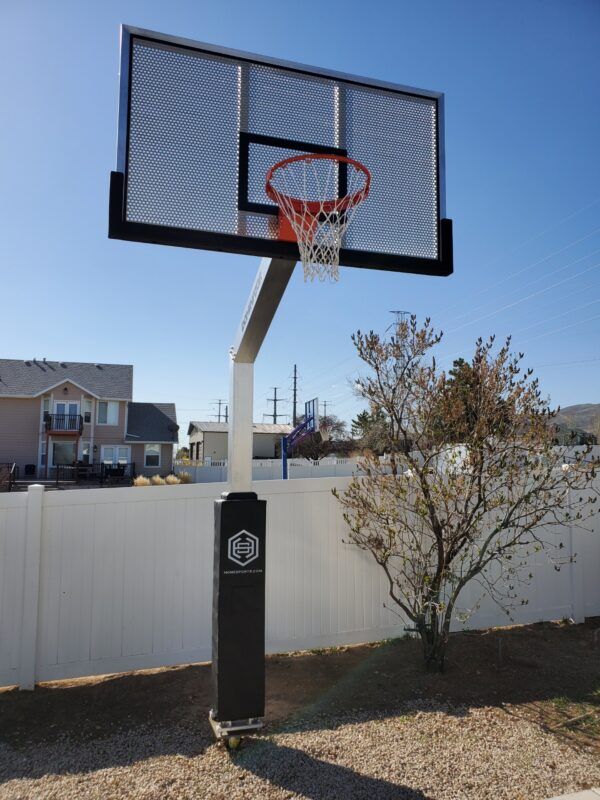
Take Your Backyard Court to the Next Level
Regulation glass backboard. Professional-grade pole. Built to develop your game for years to come.
Dominator 72" Hoop