


 Damage
  Loss
Loss  Theft
Theft 


Everything You Need to Know About Solar Panel Mounting Systems and Their Components
Solar energy has rapidly gained popularity over the past few years thanks to its reliability and cost-effectiveness. While setting up solar panels is relatively straightforward, ensuring their longevity requires thoughtful planning. The efficiency of your solar energy system heavily depends on the mounting solution you select. Typically, solar panels are mounted on rooftops or ground-level structures using specialized hardware.
The photovoltaic sector continues to expand rapidly to accommodate the growing demands of the market. Solar energy remains one of the most accessible renewable power sources available today. In this comprehensive guide, we will explore everything you need to understand about solar panel mounting structures and their essential components.
What is a Solar Panel Mounting System?
A solar panel mounting system enables you to secure solar panels onto various surfaces such as rooftops, open land, or other suitable locations. This method helps position panels at a particular angle from which they can capture the maximum amount of solar energy.
However, solar panel mounts differ from the equipment used to install solar modules themselves. Primarily, you can choose from mounting systems that track the sun's movement across the sky or alternatively opt for fixed-position mounts. Understanding these distinctions will help you identify which parts of your solar panel mounting kit serve which purpose.
Components Included in the Solar Panel Mounting Kit
A range of connectors and fastener items are used to secure solar panels in position. Independently purchased components are available, but PV modules with included mounting hardware are popular because they contain everything needed for a proper installation. The following are standard parts you can expect to find in a complete solar panel mounting kit:
1. Solar Panel Mounting Brackets
Photovoltaic brackets are essential to solar panel mounting systems. These brackets account for around 5% to 25% of the entire solar system cost. The brackets are typically designed to remain functional for decades. They are made of materials such as plastics, fiberglass, wood, or aluminum, depending on their intended application.
Solar panel mounting brackets are divided into two types based on the angle adjustment capability: fixed brackets and adjustable brackets.
2. Tilt Brackets
As the name implies, tiled brackets control how solar panels are positioned at various angles. Its inclination angle is set so that the PV modules absorb maximum sunlight; however, in the case of a fixed inclination angle, it is determined by calculating the latitude angle.
Fixed brackets are mostly preferred for their simple structure, good stability, easy operation, and low price. Nowadays, fixed brackets are increasingly replaced by ground tracking brackets for clean energy generation. These are typically constructed as either A-shaped, single-column, or double-column supports. The A-shaped design provides excellent wind resistance while maintaining structural stability.
3. Tracking Brackets
Increasingly, fixed brackets are transitionally replaced by ground tracking brackets for clean energy production. The main point of tracking brackets is that they can rotate with the sun throughout the day, which helps maximize energy generation. The Central Control comprises a sensor, cloud platform, communication, and electric control system.
Furthermore, PV mounting brackets can be L-shaped or Z-shaped, referred to as Z brackets and L brackets respectively. Usually, mounting brackets are made from aluminum or stainless steel to offer durable fixture mounting ability.
4. Mounting Clamps
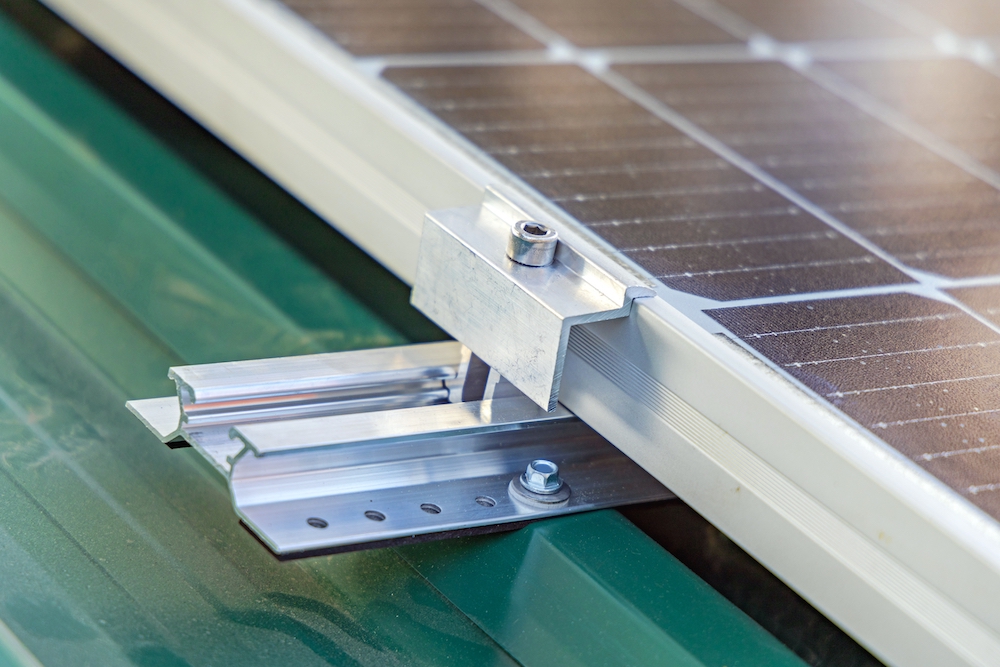
Mounting clamps are designed to secure the roof attachments to the mounting rails. There are two main types of solar mounting clamps: mid clamps (also known as inter clamps) and end clamps. Both types of clamps have the same applications.
Mid Clamps: The mid clamps are usually used to anchor the two outer panels to the rail. They are positioned on the first and last end of the outer panels.
End Clamps: End clamps are mostly used to fix edges of the solar panel to the rail during installation. Basically, they are positioned on the first and last end of the outer panels.
5. Mounting Rails and Roof Attachments
Certain solar mounting structures require rails for adjusting the PV modules. Primarily, the rails (also known as tracks) made of steel or aluminum give support to the solar panels. The roof attachments are anchored to the roof with the help of different fasteners, such as stainless steel screws, depending on the type of roof covering.
When it comes to roof attachments, these are referred to as fasteners attached to the solar modules. The stiffener fits into the slot in the rail to offer support during installation and also serves as an end cap.
6. Other Components
Apart from the equipment mentioned above, some other tools for solar panel mounts include: various types of bolts or fasteners such as hex hanger bolts and T-head bolts, stud bolts, wire clips and grommets for managing the wires.
What are the Types of Solar Mounting Systems?
1. Roof-Mounted Racks
Generally, people prefer installing rooftop mounting systems on residential buildings as it is a safer and cost-effective option. Several solar mounting structures exist which serve as the points by which panels are fixed to the system. The following are various types of roof-mounted systems:
Railed Mounting System: The railed solar panel mounting structure first uses a rail to support the solar panels. The rails are attached to the rooftop with the help of different fasteners, such as stainless steel screws.
Rail-less Mounting System: The rail-less solar panel mounting system places solar panels directly on the roof. You can simply use bolts and screws to mount the solar directly to your roof, eliminating costs, reducing or removing rails and clamps associated with rail-based mounting systems.
Shared-Rail Mounting System: The shared rail mounting system is quite similar to the railed mounting system on both rails. Unlike the traditional two Rail Mounting System, two solar panels share the shared mounting system will only use three rails instead of four.
Flat Roof Ballasted Racking System: Flat roof ballasted racking systems are ideal for situations requiring less than five mils. You can use a flat roof ballasted racking system. Typically, ballasted racking systems deploy a plug-in brick to the roof without drilling or using bolts.
2. Ground Mounts
As the name suggests, in ground mounts and solar panels are fixed on the ground. The installation is also performed at ground level of the construction site or on flat ground spaces. However, the ground mount installation is rarely done because the installation process is not as easy as on the roof.
Foundation Mounts: Foundation mounts are vertical pipes or mechanical tubes to hold the solar panels. Additionally, the ground-mounted system at this point is also called the soil mounting system because they are mounted underneath the ground by level excavation. Hence, with the help of ground-mounted concrete foundations, foundation mounts help hold solar panels in place.
Ballasted Footing Mounts: Ballasted footing mounts are a way for you to put building solar panels. This system consists of pre-cast concrete blocks attached to the ground surface. The riser fits into the concrete block and is then attached to the solar panel rails.
Pole Mounting System: The pole mounting system is pretty easy to understand and implement. It basically uses a single, tall pole anchored to the ground to redirect wind force and the solar panels are directly fixed to the top of the pole. Also commonly, pole solar mounting support PV modules during the side of the dish. Most commonly, pole mounting systems hold multiple solar panels that form an array up in the air.
3. Tracking System Mounted Racks
Another popular option is tracking brackets. This consists of a mechanical system that changes the position of the solar module during the day. This causes the sun's path to the maximum collection of solar energy. Two types of mechanical trackers are used in this case: single-axis and dual-axis.
The one-axis trackers track the sun's path from the east to the west. On the other hand, two-axis trackers track the sun's movement on daily and seasonal cycles. Two-axis trackers are usually found in commercial and utility-scale installations, while single-axis trackers are the most commonly used by residential solar projects.
How to Select the Best Solar Mounts for a Project?
Solar mounts are made of different materials such as iron, sun propellers, and brackets, depending on the application. Consequently, selecting the right mounts can be overwhelming for new buyers. The following are some characteristics of mounting materials that may help with your selection:
Aluminum
Aluminum is one of the strongest, lightweight, yet corrosion-resistant metals. It is favorable for solar panel framing; therefore, you may consider aluminum rails for your solar panel project.
Stainless Steel
Stainless steel can provide durability for countless applications for decades, so they should be preferred in wet-spray environments. You may go for stainless steel if you value longevity and corrosion resistance.
Angle Iron
Angle iron is actually made to work with angles too; it may suit to the sun. When it gets different, this drill and mounting bracket will still tolerate the environment well with the right finish and coating.
Wood
Wood is somewhat favorable for moist weather conditions for extended periods. Still, if you want to use wood, you should consider chemical treatments to slow down degradation and rotting processes.
Ready to Start Your Solar Project?
Explore our premium solar panels with included mounting feet for easy installation.
EcoFlow 400W Rigid Solar PanelConclusion
Finally, we have reached the conclusion of this guide. We have covered everything you need to understand regarding solar panel mounting systems and their components. There are specific benefits to each type of mounting structure depending on your project needs, whether it is on roof structures, ground-based, or tracking systems. Material selection also plays a crucial role in ensuring longevity and performance. Whether you are setting up a residential installation or planning a larger commercial project, understanding these fundamentals will help you make informed decisions and achieve optimal solar energy collection efficiency.