


 Damage
  Loss
Loss  Theft
Theft 


The Ultimate Guide to Portable Power Stations
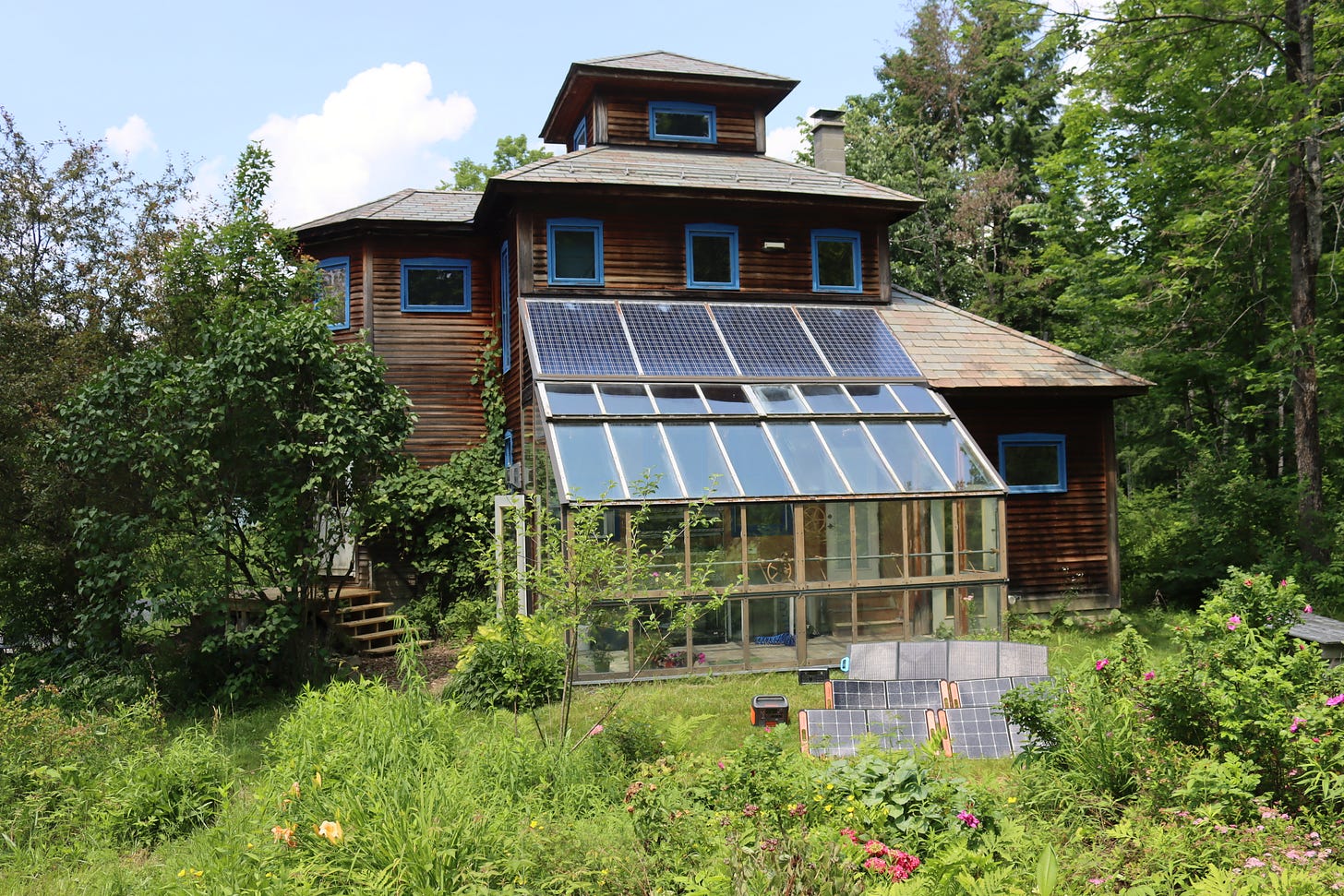
Portable power stations have completely transformed the way we think about energy independence. Whether you are setting up your backyard for a family barbecue, heading out on a weekend camping trip, or preparing for the next unexpected blackout, having a reliable source of portable electricity is no longer a luxury—it is a necessity. With power outages becoming more frequent across the country due to seasonal storms, wildfire risks, and aging utility infrastructure, there has never been a better time to invest in a dependable portable power station.
But here is the problem: the market has been flooded with dozens of brands over the past few years, many of which are cheaply made imports that barely last a season before the company behind them vanishes entirely. Sorting through all the noise can feel overwhelming. That is exactly why we put together this comprehensive guide—to help you cut through the clutter and find the absolute best portable power stations available today, while also steering you away from the ones that will leave you stranded when you need power the most.
We also understand that going fully off-grid is not practical or appealing for everyone. However, the simple peace of mind that comes from having a compact power station tucked away in a closet or garage is invaluable. You can keep phones charged during a storm, run essential medical devices like CPAP machines, keep a chest freezer from thawing out, or simply power up a fan and some lights during a sweltering summer blackout. For outdoor enthusiasts, portable power opens up a whole new world of convenience—from running a mini fridge at your campsite to powering string lights across your backyard patio for an evening under the stars.
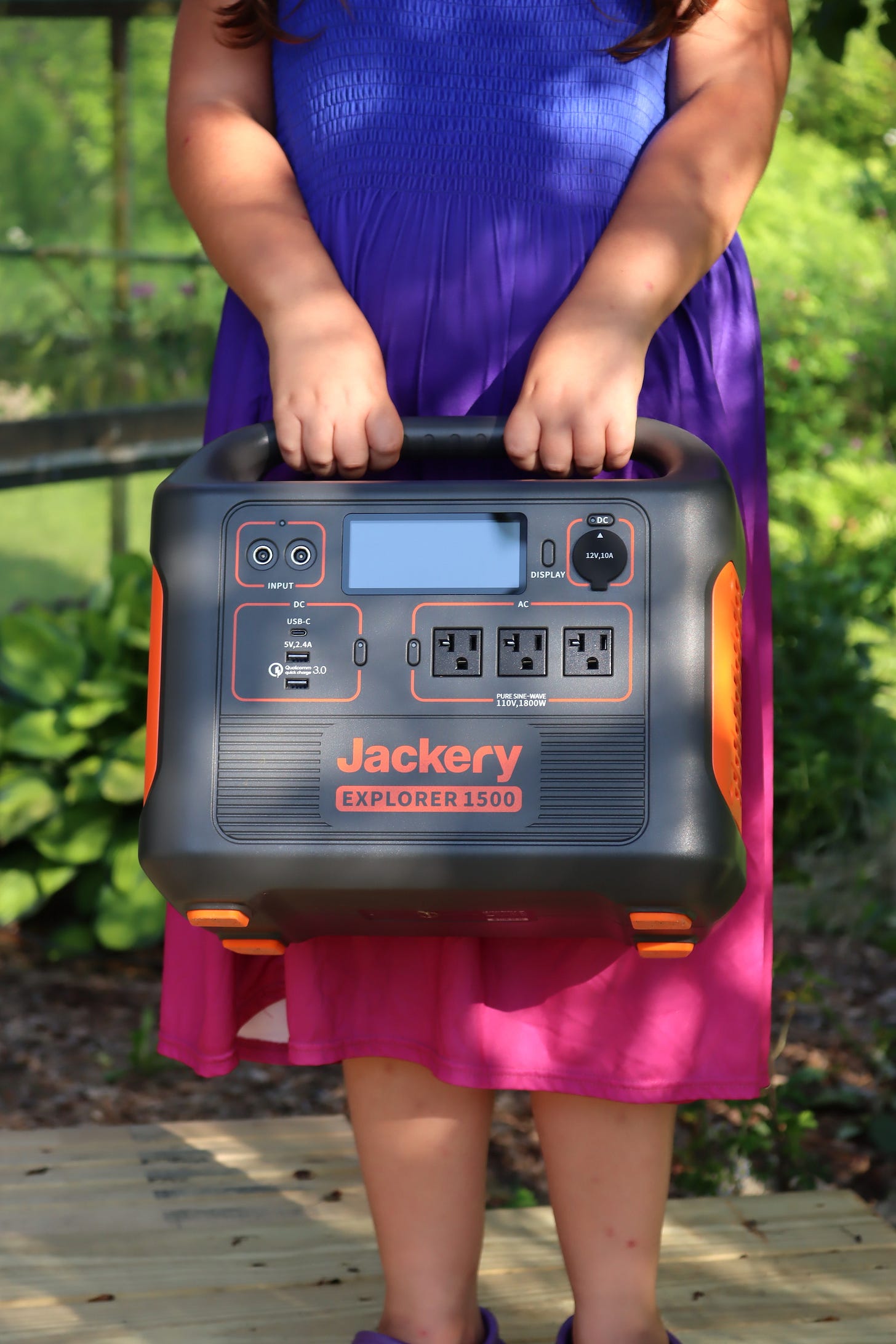
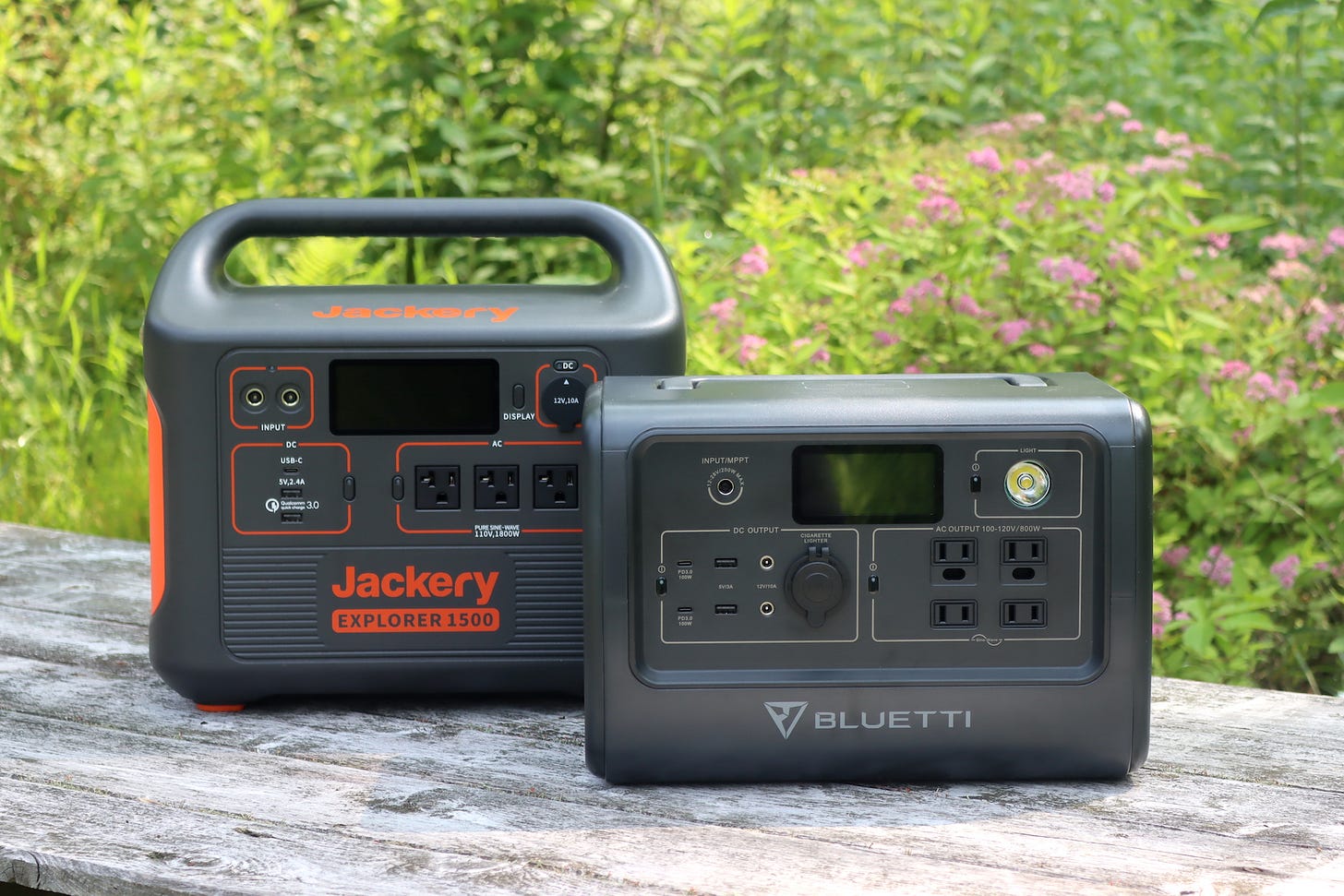
We have spent considerable time testing and researching the leading portable power station brands on the market, including Bluetti, Jackery, Goal Zero, Anker, and EcoFlow. This guide is designed to walk you through everything from battery chemistry to wattage requirements so you can make the most informed decision possible.
Our Top Picks at a Glance
This guide dives deep into the details, and we encourage you to read through it all. That said, if you are in a hurry, here are our recommended portable power stations for every common scenario:
Best Budget Option
A compact 600W LFP unit that can charge a smartphone over a dozen times, run a fan or CPAP for several hours, or keep a light going for a full day. Perfect for apartment dwellers or anyone on a tight budget who still wants dependable backup power.
Best Lightweight Station for Backpacking
Weighing in at roughly 6.5 pounds, the lightest practical option on the market. It has just enough capacity to keep devices charged and run small electronics in remote locations where every ounce in your pack matters.
Best for CPAP Users
A mid-range unit with enough juice to keep a CPAP machine running for eight to ten hours straight—getting you through a full night of sleep during a power outage. Recharge it during the day and repeat for extended outages.
Best for Car Camping
A versatile 2000+ watt-hour station that provides ample power for multi-day campsite adventures while still being light enough for a single person to lift in and out of a vehicle. Pairs beautifully with portable solar panels for off-grid recharging.
Best for RV Living
An expandable unit with a built-in TT-30 RV plug that connects directly to your RV’s electrical system. Add expansion batteries for extended trips, and pair with solar panels to keep the power flowing all week long.
Best for Emergency Whole-Home Backup
A high-capacity expandable system that outputs over 2,000 watts—enough to run most household appliances—while still being movable by a single adult. Expansion batteries can push total capacity well past 8,000 watt-hours for multi-day storm resilience.
What Exactly Is a Portable Power Station?
Think of a portable power station as an entire miniature off-grid energy system contained in a single compact unit. It is far more than just a battery. Inside every portable power station, you will find three essential components working in harmony: the battery cells that store energy, a charge controller that regulates incoming power from wall outlets, car chargers, or solar panels, and a built-in inverter that converts stored DC energy into the standard AC electricity your household devices and appliances expect.
These three internal components give rise to the three most important specifications you will encounter when shopping for a power station. First, the total watts (determined by the inverter) tell you the maximum power output at any given moment—this dictates what appliances you can run. Second, the total watt-hours (determined by the battery capacity) tell you how long you can run those appliances. Third, the charging speed (determined by the charge controller) dictates how quickly you can refill the batteries from empty to full.
What Can You Actually Run on a Portable Power Station?
The answer depends entirely on the station’s wattage rating and total watt-hour capacity. Portable power stations range from about 200 watts all the way up to 3,000 watts of output, and understanding how much power your devices draw is the key to choosing the right unit. Here is a general breakdown of common device power requirements to give you a sense of scale:
| Device / Appliance | Power Draw (Watts) |
|---|---|
| Phone Charger | 5 – 30W |
| CPAP Machine | 30 – 60W |
| Small Table Fan | 40W |
| Box Fan | 100W |
| Laptop Computer | 50 – 100W |
| Coffee Maker | 550W |
| Refrigerator | 350 – 800W |
| Blender | 500 – 1500W |
| Electric Kettle | 800 – 1500W |
| Portable AC Unit | 1000 – 1400W |
| Table / Miter / Circular Saw | 1800 – 3500W |
The key is to add up the wattage of all devices you plan to run simultaneously. You do not necessarily need a unit that can handle all your devices at once—simply using them one after another can dramatically reduce the wattage requirements. For example, making coffee first and then using an induction burner to cook breakfast means you only need enough watts for the larger of the two, rather than both combined.
For simple needs like keeping a phone charged, running a CPAP, and powering a small fan, something in the 200 to 600 watt range is more than sufficient. If you need to run appliances with heating elements—like electric kettles, pressure cookers, or induction burners—you will want a station rated at 1,500 watts or above. And if you are powering construction tools on a remote job site, look for units in the 3,000 watt range.
How Long Will a Portable Power Station Last on a Single Charge?
This is where watt-hours come in. Most portable power stations fall somewhere between 250 and 3,000 watt-hours of total capacity. The math is fairly intuitive: a 1,000 watt-hour station can theoretically run a 100-watt appliance for roughly 10 hours, or a 500-watt appliance for about 2 hours. In practice, you will get slightly less due to conversion inefficiencies—most stations deliver around 85 to 90 percent of their rated capacity when powering high-draw devices.
Keep in mind that some devices draw power continuously (like a fan or lights), while others cycle on and off to maintain a temperature (like refrigerators and air conditioners). This means real-world runtime can vary quite a bit depending on what you are powering. A standard household refrigerator, for instance, uses roughly 4,000 watt-hours over a full 24-hour period, so you would need a sizable battery to keep it running through a multi-day outage.
If you are planning for short-term outages or occasional campsite use, a mid-range unit between 500 and 1,500 watt-hours will serve most people well. For extended multi-day backup power for an entire household, you will want to look at expandable systems that push well into the 4,000 to 8,000+ watt-hour range.
How to Choose the Right Portable Power Station
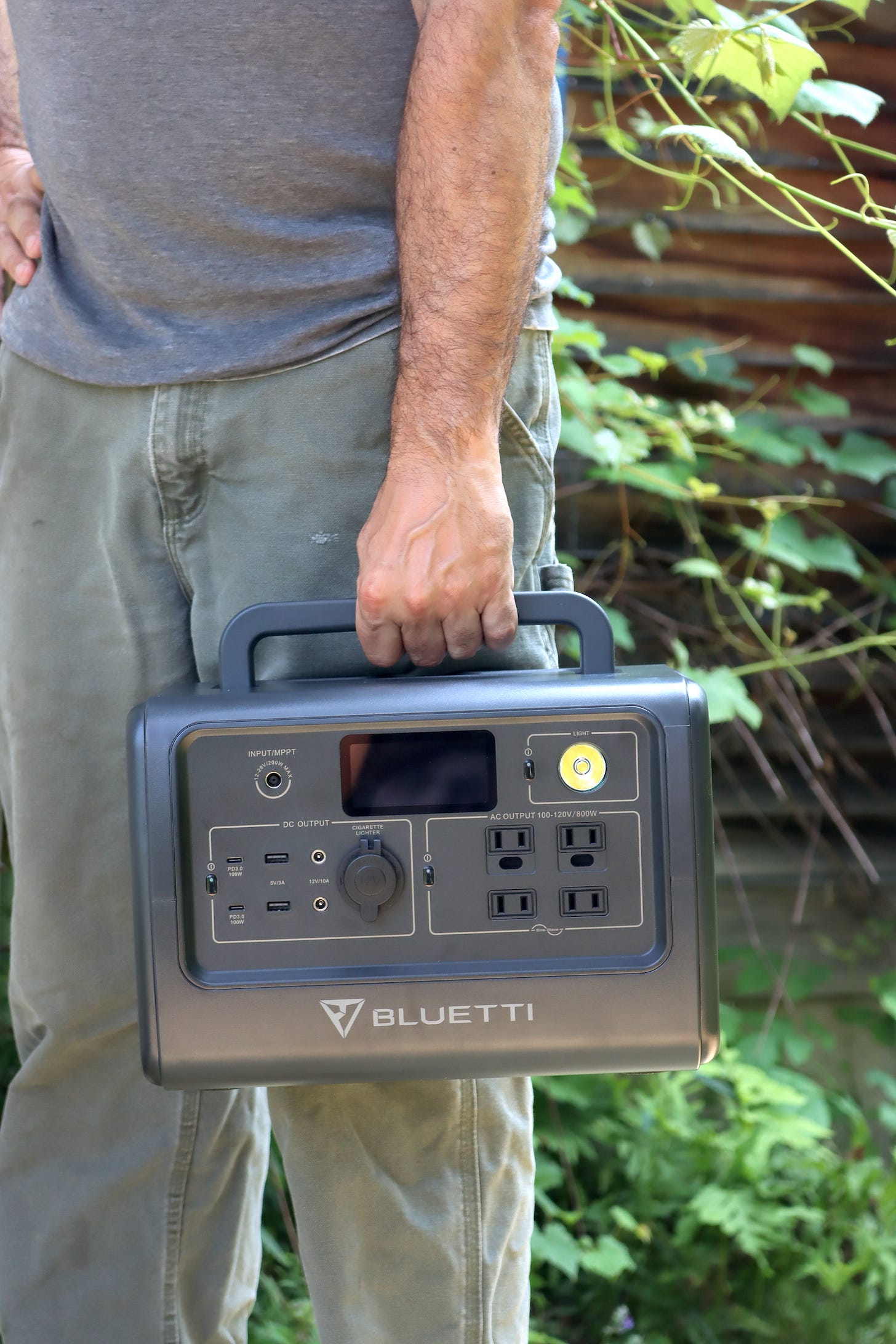
When selecting a portable power station, there are several critical factors to consider beyond just the headline wattage number. Physical weight matters—the smallest units weigh as little as five or six pounds but are limited to around 200 to 300 watts, while the largest units can tip the scales at over 100 pounds and power an entire home. The sweet spot for most buyers falls in the 20 to 40 pound range, offering a solid balance of portability and capability.
Total watt output determines what appliances you can operate. A 1,000 watt unit covers approximately 93 percent of common household appliances. Stepping up to 1,500 watts gets you to around 95 percent coverage, adding power-hungry items like electric pressure cookers and waffle irons. A 2,000 watt unit handles virtually everything short of full-size electric stoves and clothes dryers, and is particularly useful when you need to power several smaller appliances simultaneously.
Battery Chemistry: The Most Important Decision
Out of all the specifications and features you will encounter, the type of battery inside a portable power station is arguably the single most important factor in your purchase decision. There are two primary chemistries in use today, and they differ dramatically in terms of lifespan, safety, weight, and cost.
Lithium NMC (Nickel Manganese Cobalt)
This is the older battery technology used by brands like Jackery and Goal Zero. It is lighter weight, which makes it appealing for camping and backpacking. However, NMC batteries are only rated for approximately 500 charge cycles, which translates to roughly two to four years of regular use. They degrade rapidly if you frequently discharge them below 50 percent capacity, and they are considered slightly less safe than the newer LFP technology. The key advantage is weight savings of about 20 to 30 percent compared to equivalent LFP batteries.
LFP / LiFePO4 (Lithium Iron Phosphate)
This is the newer, more advanced battery technology used by brands like Bluetti, Anker, and many newer EcoFlow models. LFP batteries are rated for 2,500 to 3,500 charge cycles, giving them a useful lifespan of 10 to 20+ years. They can be safely discharged all the way down to zero percent without any degradation, and they are inherently more stable and less prone to safety issues. They are slightly heavier and marginally more expensive, but for home backup and long-term use, they are the clear winner.
Charging Methods and Speed
Every major portable power station on the market supports three core charging methods: a standard AC wall outlet, a DC car charger, and DC solar panel input. This covers the needs of the vast majority of users. Some premium models offer additional charging methods—including the ability to charge from lead-acid batteries, dual AC inputs, or simultaneous solar and AC charging—which can be useful in extreme emergency scenarios.
Where manufacturers differ significantly is in charging speed. Some models are limited to just 100 to 200 watts of input power, resulting in painfully slow 16+ hour charge times even for moderately sized batteries. Others feature fast-charging technology that can take a depleted unit from zero to full in under two hours. The average falls in the two to four hour range for most mid-tier power stations from reputable brands.
One often overlooked fact is that slower-charging models are not necessarily cheaper. Many of them cost the same as faster alternatives and simply bury their slow charge times in the fine print. When two similarly priced options offer comparable capacity, it always makes sense to choose the one with faster charging capability.
Brand-by-Brand Breakdown
Now that you understand the core technical specifications, let us walk through the major portable power station brands on the market. Each has its strengths and trade-offs, and the right choice depends on your specific needs and priorities.
Bluetti — Best for Home Backup & Long-Term Reliability
Launched in 2019, Bluetti has quickly become one of the most trusted names in the portable power space, largely thanks to their early and wholehearted commitment to LFP battery technology. Their batteries are rated for 2,500 or more charge cycles, which equates to well over two decades of reliable service. They are also inherently safer than NMC alternatives.
Bluetti stands out by offering up to seven different charging methods on their larger units, covering virtually every conceivable power source you might have access to in an emergency. Their output options are equally comprehensive—standard AC outlets, USB-A, USB-C, DC carport, wireless charging pads, and TT-30 RV plugs on select models.
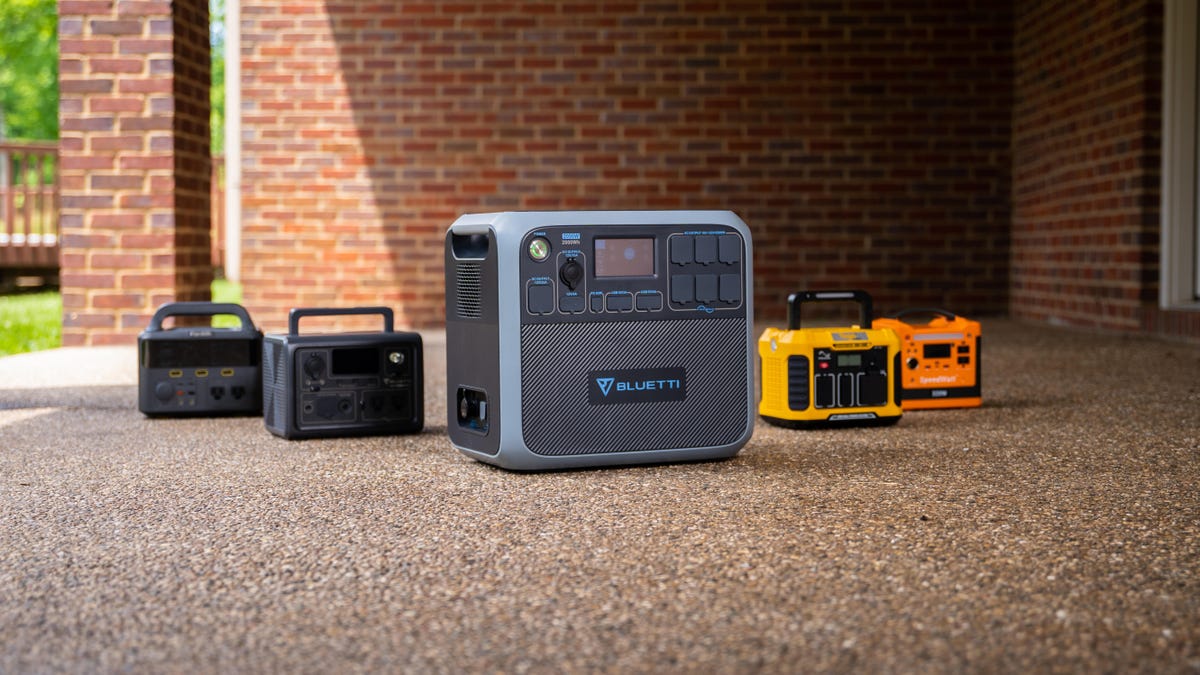
Their product range spans from compact 10-pound units with 600 watts of output all the way up to massive expandable whole-home systems. The expandable models, such as the AC200Max, start at around 2,000 watt-hours and can be scaled up to 8,000+ watt-hours with add-on battery modules. For home emergency backup and long-term investment, Bluetti is hard to beat.
Jackery — Best for Camping & Portability
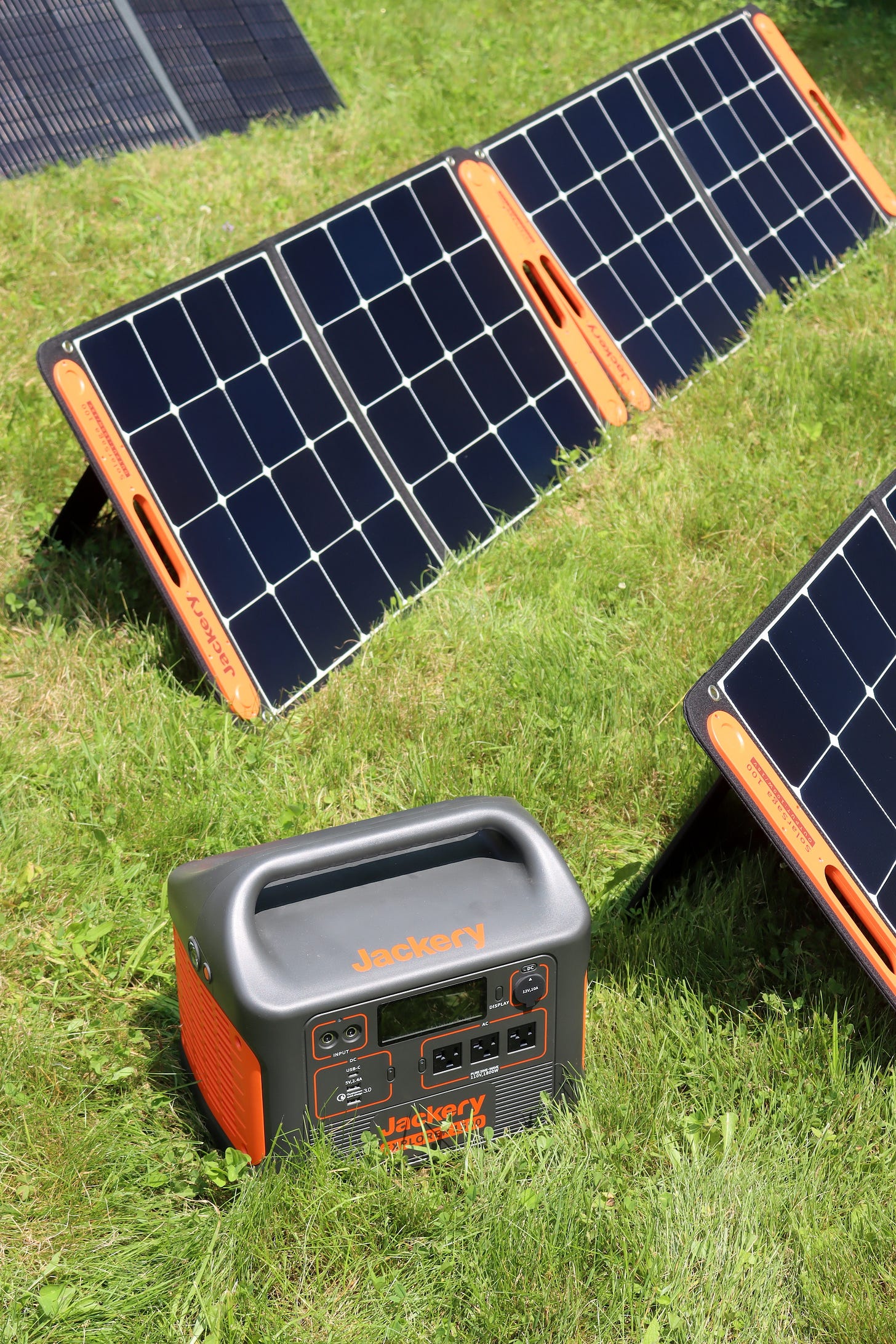
Founded in California back in 2012, Jackery was one of the original pioneers in the portable power station market, specifically targeting campers and outdoor enthusiasts. They have sold over two million units worldwide, and their reputation for ease of use and portability is well-earned. Each unit features a built-in carrying handle and pairs seamlessly with their lightweight folding solar panels.
Jackery uses NMC lithium batteries, which makes their units roughly 30 percent lighter than comparably sized LFP alternatives. The trade-off is a shorter lifespan—approximately 500 charge cycles, or two to four years of daily use. Their batteries also degrade faster when regularly discharged below half capacity. For camping and recreational use where light weight is a priority, this trade-off often makes sense.
Their product line runs from the ultralight 240 watt-hour Explorer 240 at just 6.5 pounds all the way up to the Explorer 3000 Pro with 3,024 watt-hours. Jackery backs their products with a solid three-year warranty, extendable to five years with product registration.

Goal Zero — A Hard Recommendation to Make
Goal Zero has a loyal following and builds solid hardware, but in today’s competitive landscape, they are difficult to recommend over the alternatives. Their power stations use the same NMC battery chemistry as Jackery but tend to be heavier, more expensive, and—most critically—they charge excruciatingly slowly. We are talking charge times that can stretch past 16 hours for a full battery, which is nearly ten times slower than some competitors at the same price point.
If you already own a Goal Zero unit and are happy with it, there is no reason to switch. But if you are making a new purchase, a comparably sized and priced Jackery unit will charge dramatically faster while offering similar portability and weight characteristics.
Anker — Strong LFP Competitor
Anker is a well-established electronics brand that has brought their reputation for quality into the portable power station market. Like Bluetti, they use the superior LFP battery technology, which means long lifespan, deep discharge capability, and excellent safety profiles. Their Solix line has received strong reviews for build quality, intuitive interfaces, and competitive pricing.
Anker is an excellent choice if you find a model that fits your specific capacity and wattage needs. They tend to offer fewer size options than Bluetti, but the models they do produce are consistently well-made and fairly priced.
EcoFlow — The Speed Champion
EcoFlow has carved out a niche by focusing heavily on ultra-fast charging speeds. Their flagship units can go from completely dead to fully charged in under an hour for smaller models and under two hours for larger ones. If rapid recharging is your top priority, EcoFlow is the standout choice.
One thing to be aware of is that EcoFlow uses a mixture of NMC and LFP batteries across their product line, and it is not always immediately clear which chemistry a given model uses. This is an important distinction—make sure to verify the battery type before purchasing, especially if longevity and deep-discharge safety are important to you. Their newer models, including the Delta Pro 3 series, have moved to LFP batteries, which is a very positive development.
What About the Worst Portable Power Stations?
The worst options on the market are almost universally the cheap, mass-produced generic units that have flooded online marketplaces in recent years. Many of these brands approach reviewers for promotional partnerships, only to disappear within months as poor reviews and product failures pile up. They then rebrand under a new company name, swap the casing color, and start the cycle all over again.
When you are buying a battery system that you may need to depend on in an emergency, it genuinely pays to invest in a recognized brand, even if it costs a bit more. Poorly manufactured lithium batteries, particularly the NMC type, can pose real safety hazards. A bargain-bin power station is not a bargain if it fails when the lights go out—or worse, becomes a liability.
If budget is a concern, the smartest move is not to buy a cheap knockoff. Instead, consider purchasing a smaller unit from a reputable manufacturer. A compact, well-built 600-watt LFP station will serve you far better than a large, questionable unit from an unknown brand. If you go the used route, stick exclusively to LFP models from established brands—they are rated for thousands of charge cycles and are incredibly difficult to damage even with heavy use. Avoid used NMC units, as they degrade rapidly and may already be near the end of their useful life.
A Quick Note on Portable Solar Panels
Every portable power station on the market doubles as a solar generator—they all accept DC input from compatible solar panels. This gives you the ability to recharge your batteries entirely off-grid using nothing but sunlight. Portable solar panels have gotten remarkably good in recent years, with sleek folding designs, lightweight construction, and surprisingly efficient energy capture.
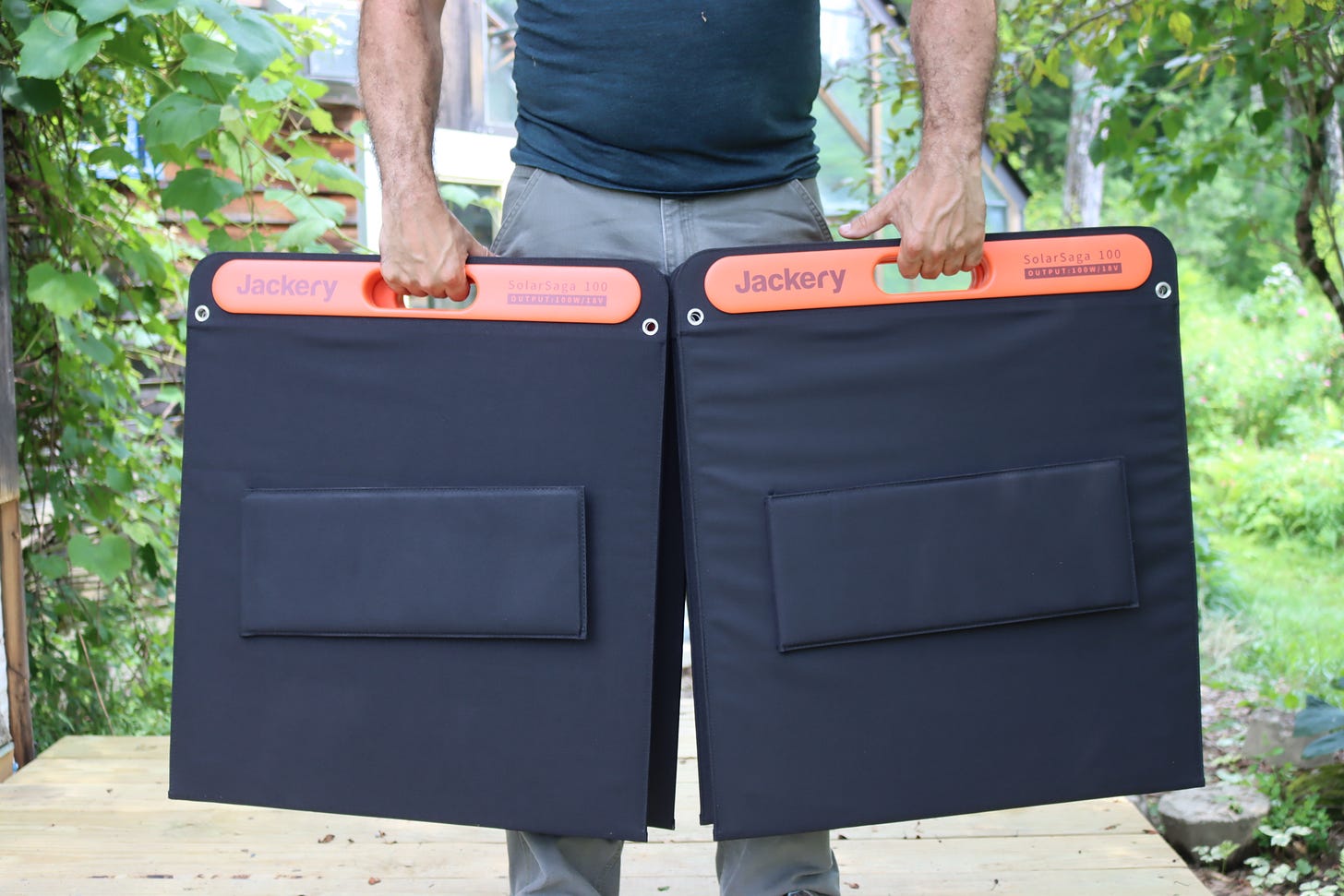
For most users, a 100-watt panel strikes the ideal balance between charging speed, portability, and ease of use. They unfold quickly, stay positioned well, and pack down compactly. Larger 200-watt panels charge batteries faster but are bulkier and heavier. The best approach is to match your panel wattage to your power station’s solar input capacity—most manufacturers offer compatibility guides to make this straightforward.
Expand Your Power Capacity
Add serious backup energy with the EcoFlow DELTA Pro 3 Smart Extra Battery.
EcoFlow DELTA Pro 3 Extra BatteryFinal Thoughts
Portable power stations have come a long way in just the last few years. The technology is better, the prices are more accessible, and the options available to consumers have never been more diverse. Whether you need a compact unit to keep your phone charged and a fan running during a summer blackout, a versatile mid-range station for weekend camping trips, or a serious expandable system to keep your entire household running through a multi-day outage, there is a power station out there that fits your needs and budget.
The most important takeaway from this guide is to prioritize battery chemistry and brand reputation above all else. For stationary home use and long-term investment, LFP batteries from brands like Bluetti, Anker, and newer EcoFlow models are the clear choice. For lightweight camping and portability, Jackery’s NMC offerings remain excellent. And no matter your budget, always choose a recognized manufacturer over an unknown bargain brand—your future self will thank you when the power goes out and your station fires up exactly as it should.
Stay prepared, stay powered, and enjoy the freedom that comes with having reliable portable energy wherever life takes you.