


 Damage
  Loss
Loss  Theft
Theft 


Sodium-Ion vs Lithium-Ion: Which Battery Wins?
Introduction
The energy storage world has never moved faster. Two technologies are now competing at the forefront of the battery market: sodium-ion and lithium-ion. While lithium-ion has dominated for decades — powering everything from electric vehicles to off-grid solar systems — sodium-ion is rapidly closing the gap, bringing significant advantages in safety, cost, and raw material availability.
Understanding the differences between these two battery types is no longer just for engineers. If you're investing in energy storage — whether for a home, a vehicle, or an off-grid system — knowing which technology suits your needs could save you time, money, and frustration.
Technical Overview
Electrochemical Performance
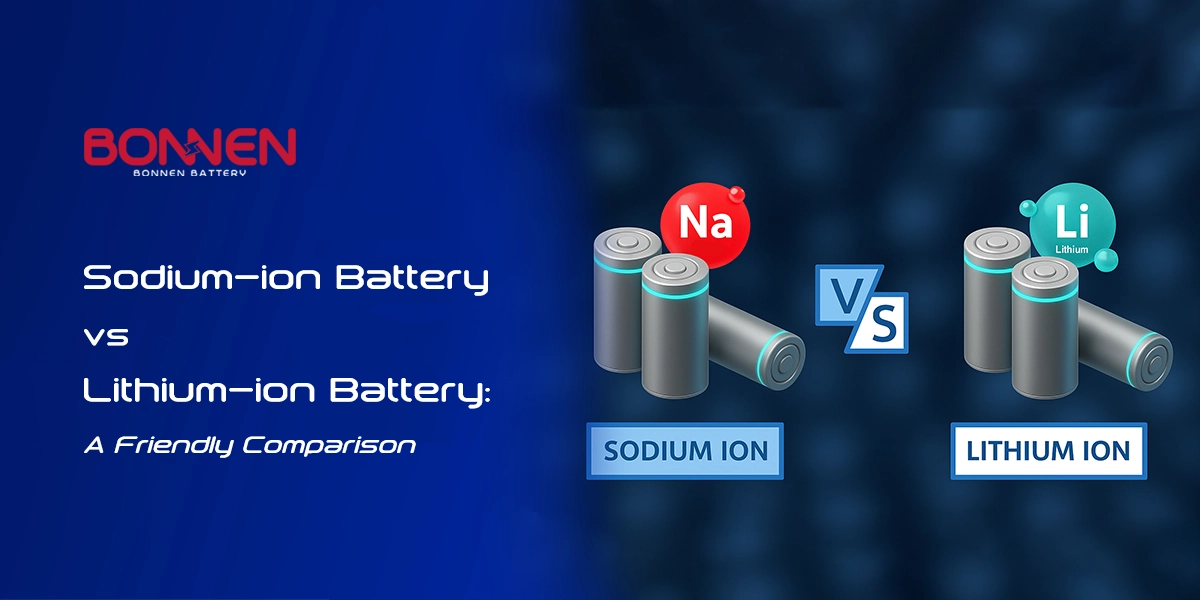
At their core, both battery types work on the same principle — ions move between anode and cathode to generate and store electricity. The key difference is which ion does the moving. Lithium-ion batteries use lithium ions, which are small, lightweight, and highly reactive, resulting in high energy density. Sodium-ion batteries use sodium ions, which are larger and slightly heavier but far more abundant and chemically stable.
In practical terms, this translates to measurable differences in energy density, cycle life, temperature tolerance, and rate of charge. The table below summarizes the primary electrochemical distinctions:
| Specification | Sodium-Ion | Lithium-Ion (LFP) |
|---|---|---|
| Energy Density | 100–160 Wh/kg | 150–200 Wh/kg |
| Cycle Life | 3,000–5,000+ cycles | 2,000–4,000 cycles |
| Operating Temperature | −40°C to 60°C | −20°C to 55°C |
| Charge Rate | Up to 3C fast charge | Up to 2C (LFP) |
| Self-Discharge Rate | Low | Very Low |
| Depth of Discharge | Up to 100% | 80–90% recommended |
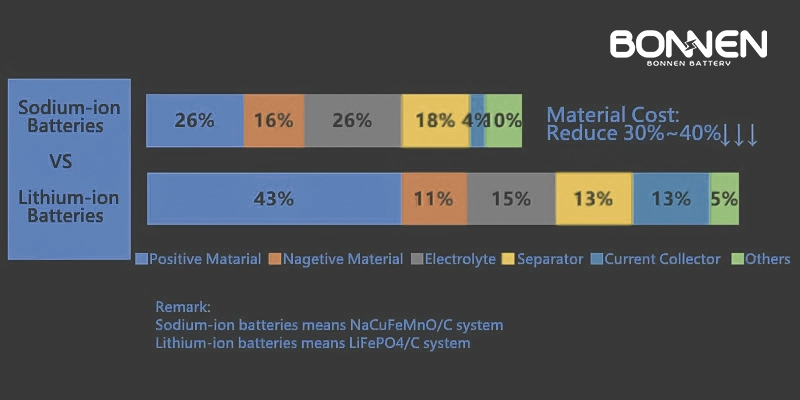
| Raw Material Cost | Very Low (sodium abundant) | Moderate–High (lithium, cobalt) |
| Thermal Runaway Risk | Very Low | Low–Moderate |
How They're Built
Cell Structure
The internal architecture of sodium-ion and lithium-ion cells shares similarities, but key differences in electrode materials drive performance distinctions. Lithium-ion cells typically use graphite anodes and a range of cathode materials — LFP (lithium iron phosphate), NMC (nickel manganese cobalt), and NCA (nickel cobalt aluminum) being the most common. Each cathode chemistry brings trade-offs in energy density, safety, and cost.
Sodium-ion cells, on the other hand, commonly use hard carbon anodes paired with layered oxide or Prussian blue analog cathodes. Hard carbon is inexpensive and widely available. Importantly, sodium-ion cells can be manufactured on the same production lines as lithium-ion cells — dramatically reducing the capital investment required to scale production.
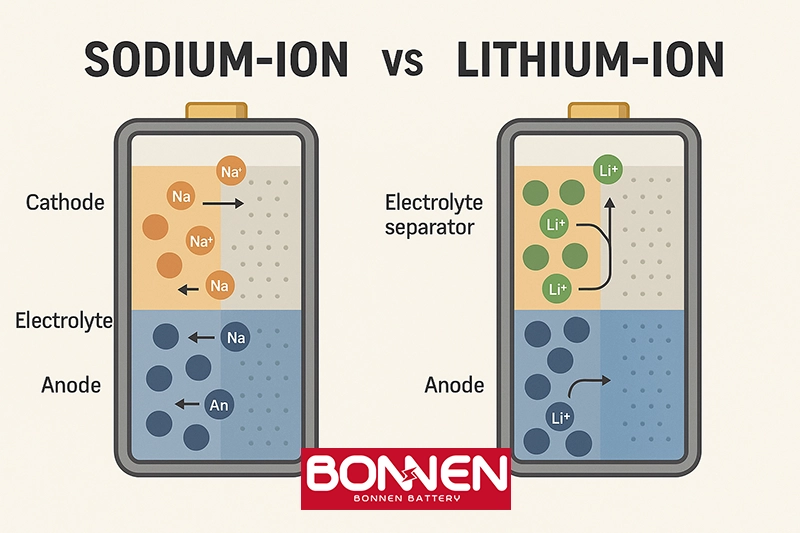
One notable advantage of sodium-ion construction: the cells can be stored and shipped in a fully discharged state. This is a significant safety and logistics benefit — lithium cells must be shipped with a partial charge to prevent damage. For manufacturers and distributors, this simplifies storage, reduces fire risk in transit, and lowers shipping classification requirements.
Where They're Used
Real-World Applications
Both technologies serve a wide range of applications, but each has specific use cases where it excels. Lithium-ion remains the gold standard for high-energy-density applications — electric vehicles requiring maximum range, portable consumer electronics, and aerospace applications all benefit from lithium's superior energy per kilogram.
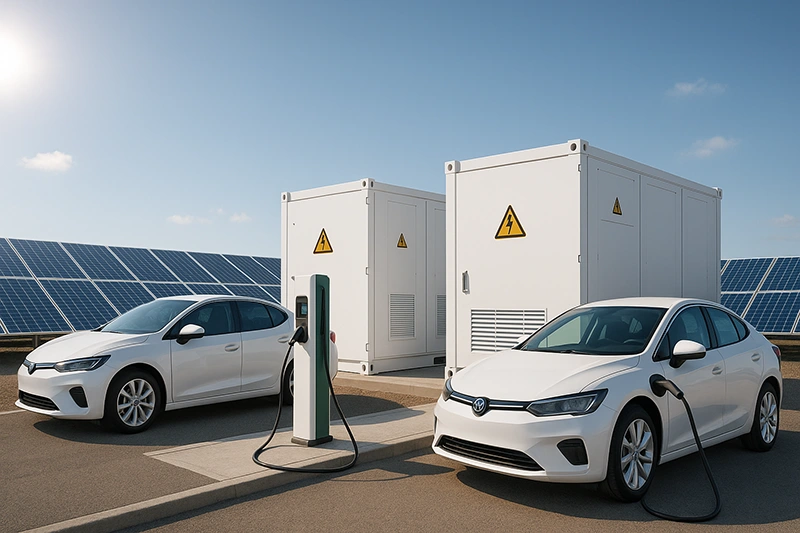
Sodium-ion technology shines in stationary and semi-mobile energy storage. Off-grid solar banks, grid-scale storage installations, RV and marine battery systems, and industrial backup power are all compelling use cases. The wider temperature tolerance is a particular advantage — sodium-ion batteries maintain strong performance in extreme cold where lithium-ion performance drops noticeably.
⚡ Sodium-Ion — Best For
- Off-grid solar energy storage systems
- RV, marine, and mobile power banks
- Cold climate installations (down to −40°C)
- Grid-scale stationary storage
- Budget-conscious large capacity builds
- Applications demanding maximum cycle life
🔋 Lithium-Ion — Best For
- Long-range electric vehicles
- Consumer electronics and portables
- Applications where weight is critical
- High discharge rate power tools
- Aerospace and precision instruments
- Space-constrained installations
Safety & Sustainability
Safety & Environmental Impact
Safety is one of the most significant differentiators between these two chemistries. Lithium-ion batteries — particularly NMC and NCA variants — carry a non-trivial risk of thermal runaway: a chain reaction that can lead to fire or explosion under abuse conditions such as overcharge, physical damage, or extreme heat. LFP lithium batteries are considerably safer than NMC, but sodium-ion takes the lead across all chemistries.
FRIENDLY
A Cleaner Energy Future
Sodium-ion batteries represent a meaningful step toward genuinely sustainable energy storage — using Earth-abundant materials, safer chemistry, and longer service lives to reduce the total environmental burden of the global energy transition.
Industry Landscape
The Sodium-Ion Battery Market
The sodium-ion battery market has entered a phase of rapid commercial maturation. Major manufacturers — including CATL, BYD, and a growing roster of specialized producers — have announced production commitments and commercial product lines. Global sodium-ion battery production capacity is projected to scale dramatically through 2026 and beyond.
Adoption is accelerating in China, Europe, and North America, driven by grid-scale energy storage procurement, EV manufacturers seeking alternatives to lithium dependency, and the off-grid and RV markets demanding safer, longer-lasting power solutions. Analysts project the sodium-ion market to reach multi-billion dollar scale within the next three to five years.
For consumers, this scaling means one thing: prices are falling and availability is improving. Premium sodium-ion products are already on the market today, delivering real-world performance that rivals or exceeds lithium-ion LFP in many application scenarios.
Ready to Make the Switch?
The Limitless Lithium NoLi Sodium 50Ah Battery delivers the next generation of sodium-ion performance in a compact, ready-to-install package — built for off-grid systems, RVs, marine applications, and anyone who demands safe, long-lasting power without compromise.
Limitless Lithium NoLi Sodium 50Ah
Premium sodium-ion chemistry. 5,000+ cycle life. Safe for cold climates and demanding installations. Ships fully discharged for safety. Built for the serious off-grid enthusiast.
The Battery Landscape Has Changed
Sodium-ion technology is no longer experimental — it's here, it's proven, and in many applications it outperforms the lithium-ion cells it's replacing. Whether you're building an off-grid solar array, outfitting an RV, or simply looking for the safest and most sustainable energy storage option available, sodium-ion deserves serious consideration.
Shop NoLi Sodium 50Ah