


 Damage
  Loss
Loss  Theft
Theft 


A Complete Guide to Hydraulic Systems for Heavy Equipment
Hydraulic systems are the silent powerhouse behind nearly every piece of heavy equipment used in construction, agriculture, and outdoor work. From excavators and backhoes to log splitters and tractors, hydraulics deliver force, control, and precision that would be impossible to replicate with mechanical systems alone. This guide explains exactly how they work and why understanding them makes you a smarter equipment owner.

Introduction to Hydraulic Systems
A hydraulic system is a method through which mechanical force and motion are transmitted using pressurized fluid. When an operator presses a lever or pedal in the cab of a machine, the hydraulic system instantly multiplies that input into a massive output force — enough to lift a loaded bucket, push through compacted earth, or extend a boom arm dozens of feet into the air.
The basic principle at work is Pascal's Law: pressure applied to a confined fluid is transmitted equally in all directions. In practical terms, this means a small pump can generate enormous lifting or pushing force at the cylinder end of the system. This principle is why relatively compact hydraulic equipment can outperform what would otherwise require multiple mechanical systems to accomplish.
How Do Hydraulic Systems Function?
The function of a hydraulic system in heavy equipment centers on converting mechanical power into fluid power and back again. Here's the sequence that takes place every time an operator moves a control:
Fluid Storage & Draw
Hydraulic fluid is stored in a reservoir. The pump draws this fluid in whenever the engine is running.
Pressurization
The pump pressurizes the fluid and pushes it through the circuit at high pressure — often hundreds to thousands of PSI.
Control via Valves
Valves regulate the direction and flow of pressurized fluid, routing it to whichever actuator the operator is commanding.
Work Output at the Cylinder or Motor
Hydraulic cylinders convert pressure into linear force. Hydraulic motors convert pressure into rotary movement. Together, they perform the actual work — lifting, pushing, rotating, and clamping.
Return & Filtration
Spent fluid returns through the circuit back to the reservoir, passing through filters to remove contaminants before being used again.
This closed-loop design makes hydraulic systems highly efficient and surprisingly long-lived when maintained correctly.
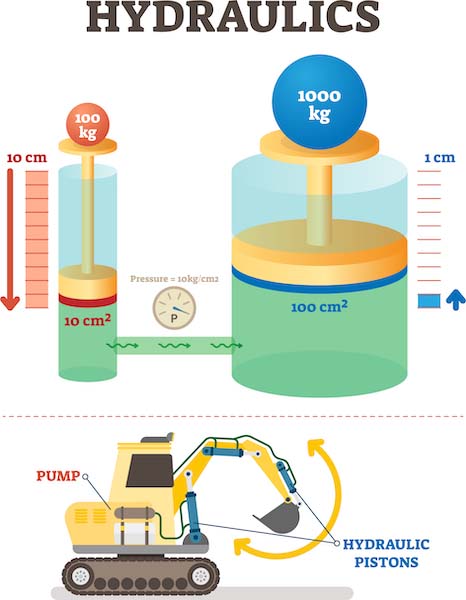
Key Components of a Hydraulic System
Every hydraulic system — from a simple log splitter to a full-size excavator — shares the same core set of components. Understanding each one helps you diagnose issues, maintain your equipment, and choose the right hydraulic kit for your application.
| Component | Function |
|---|---|
| Hydraulic Pump | Converts mechanical energy from the engine into pressurized fluid flow. The heart of the entire system. |
| Hydraulic Cylinders | Convert fluid pressure into straight-line pushing or pulling force. Used for lifting, extending, and tilting. |
| Control Valves | Direct pressurized fluid to specific actuators, controlling speed, direction, and pressure limits. |
| Reservoir / Tank | Stores hydraulic fluid, allows heat dissipation, and provides a buffer for fluid volume changes. |
| Hydraulic Lines & Hoses | Carry pressurized fluid between all components. High-pressure rated and critical to system integrity. |
| Filters | Remove particles and contaminants from fluid before it re-enters the pump, protecting the entire circuit. |
| Hydraulic Motors | Convert fluid pressure into rotary motion — used for tracks, augers, conveyors, and rotating attachments. |

Hydraulic Pumps
Gear pumps, piston pumps, and vane pumps are the three main types. Piston pumps handle the highest pressures and are common in heavy construction equipment. Gear pumps are simpler and found widely in agricultural machinery.
Valves
Directional control valves, pressure relief valves, and flow control valves each serve a distinct role. Together, they protect the system from over-pressure events while precisely managing output movement.
Reservoirs
More than just a tank — the reservoir manages fluid temperature, allows air and contaminants to settle out, and keeps an adequate volume of fluid available at all times regardless of load demand.
Types of Hydraulic Systems
Not all hydraulic systems are built the same. The type used depends on the machine's demands, the precision required, and how the system manages fluid flow.
Open-Center System
Fluid circulates back to the reservoir when controls are neutral. Simple and cost-effective — used widely on older tractors and basic construction equipment.
Closed-Center System
Pump output is blocked when controls are neutral, with pressure maintained in the circuit. Enables multiple functions to run simultaneously with greater control.
Load-Sensing System
The pump delivers only as much flow as the system currently demands, dramatically reducing energy waste and heat generation in variable-load applications.
Hydrostatic System
Uses a hydraulic pump and motor in a direct loop for drive power — common in skid steers, compact loaders, and zero-turn mowers.
Hydraulic Power Units (HPUs)
A Hydraulic Power Unit is a self-contained package that combines the pump, motor, reservoir, and controls into one compact unit. HPUs are the go-to solution for equipment that needs hydraulic power without a full vehicle-mounted system.

Single-Stage Pumps
Deliver consistent pressure at a single rate. Ideal for straightforward applications like log splitters, tilting platforms, and simple lifts.
Two-Stage Pumps
Operate at high flow for rapid movement and automatically switch to high pressure for the heavy work. More efficient for cycle-intensive operations.
Operator Controls
Modern HPUs include directional valves, speed controls, and pressure limiters so operators can tune system behavior without mechanical adjustments.
Hydraulic Machines Used in Construction & Agriculture
Hydraulic systems are standard equipment across a wide spectrum of machines. Whether you're breaking ground on a new build or working land on a farm, hydraulics are doing the heavy lifting.
Each of these machines relies on its hydraulic system not just for power, but for the fine control that makes precise operation possible. A crane that can't feather its load or a bucket that can't tilt to the right angle is a liability — hydraulics provide the nuance that makes these machines genuinely useful on the job site.

MotoAlliance 6-Piece Agricultural Hydraulic Kit
A complete hydraulic system solution designed for agricultural use — everything you need to add or restore hydraulic capability, in one precision-engineered package.
Final Thoughts
Hydraulic systems are one of the most reliable technologies in modern equipment — when you understand how they work, you can maintain them better, troubleshoot issues faster, and choose the right tools for the job. Whether you're running a full excavator or adding hydraulic attachments to a tractor, the core principles remain the same: pressure, flow, and controlled output. Investing in quality hydraulic components and keeping your fluid clean are the two most important steps you can take toward long-term system health.
At Backyard Provider, we stock the hydraulic kits, power units, and accessories that serious equipment owners rely on. Explore our selection and build the system your work demands.