


 Damage
  Loss
Loss  Theft
Theft 


Visual Inspection Methods, Techniques & Benefits
The majority of industrial equipment and structures begin showing signs of degradation after years of continuous use. Catching these early signs of wear or deterioration helps reduce maintenance expenses and keeps operations compliant with safety regulations.
Visual inspection has served as a foundational practice for monitoring the condition of assets since the dawn of industrial manufacturing. In recent decades, however, major innovations have transformed the tools and techniques available for visual testing.
In this guide, we explore the core principles of visual testing — including common use cases, recommended inspection schedules, modern approaches, and the leading equipment options for gathering reliable, high-quality data in the field.
What is Visual Inspection?
Visual inspection involves the direct observation of a surface to identify abnormalities, flaws, or signs of damage. It can be conducted as a standalone evaluation to verify an asset's characteristics and overall condition, or it can be paired with additional non-destructive testing (NDT) techniques to gather more detailed data about the location, severity, and impact of any defects found.
To carry out these assessments, inspectors rely on portable or fixed HD cameras, unmanned aerial vehicles, tablets, and specialized software for image analysis. For instance, inspection drones can scan structures for voids, cracks, or material thinning by employing mounted ultrasonic testing probes or electromagnetic acoustic transducers (EMAT).
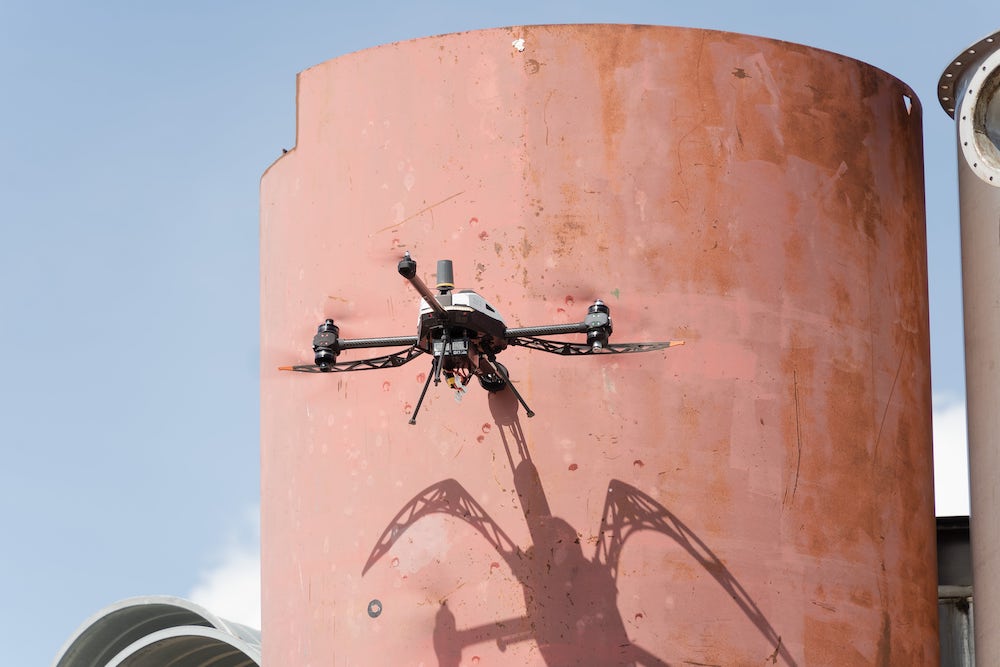
Source: Industrial inspection drone performing EMAT analysis on a chimney.
With breakthroughs in machine learning (ML) and deep learning (DL), it is now feasible to detect even the smallest irregularities in an object's shape, texture, color, or alignment — effectively removing subjectivity and guesswork from the inspection process.
What Should a Technician Look for During a Visual Inspection?
As a general rule, inspectors should watch for any irregularities in the asset's surface, dimensions, or coloration that could point to a quality concern, damage, or deterioration.
Visual evaluations help technicians spot surface-level problems such as cracks, dents, warping, peeling, corrosion, or discoloration. When used alongside liquid penetrant testing or magnetic particle testing, visual inspection also confirms the proper application of developer agents and pinpoints their exact location on the part.
Where is Visual Testing Used?
Visual inspections are performed across a wide range of industries for the purposes of quality control and non-destructive testing.
In manufacturing environments, high-resolution cameras paired with machine learning algorithms are commonly used to automate visual quality checks. Leading technology companies have deployed AI-driven video analytics to audit product configurations on conveyor belts, enabling the inspection of each unit in under two minutes.
In the realm of non-destructive testing, visual methods help uncover surface-level defects and textural anomalies on active industrial assets including storage tanks, heat exchangers, and offshore platforms. Using advanced inspection drones, telecom operators have been able to examine more than ten communication towers daily, checking for environmental damage and measuring protective coating thickness.
Applications of Visual Testing
| Industries | Defect Types | Assets |
|---|---|---|
| Automotive | Surface level (scratches, dents, cracks) | Pipelines |
| Manufacturing | Dimensional defects (misalignment, warps) | Pressure vessels |
| Electronics | Texture irregularities (bumps, blistering) | Welded structures |
| Energy | Color changes (fading, rust, discoloration) | Power generation equipment |
| Telecom | Storage tanks | |
| Infrastructure | Railway infrastructure | |
| Pharmaceuticals | Nuclear facilities | |
| Textile / Mining | Automotive components |
How Often Should You Perform Visual Testing on Assets?
The recommended frequency for visual inspections varies based on the type of asset involved and the quality or safety standards that apply.
Structural Welds
Per the AWS B1.11:2000 standard, 100% of structural welds require visual inspection. The ASME B31.3 regulation similarly mandates 100% visual examination of piping system welds.
Storage Tanks
Above-ground storage tanks should be inspected every 5 years when in service for under a decade, and every 3 years for tanks in use beyond 10 years, as outlined by API 653.
Bridges
Bridges require damage inspections every 12, 24, or 48 months, depending on their design and condition, according to federal transportation guidelines.
As a general principle, more frequent asset inspections help catch early warning signs of degradation and prevent expensive repairs or unexpected failures down the line.
Pros and Cons of Visual Inspection
A quick visual assessment is typically the first step in most inspection workflows. If damage is already apparent to the naked eye, there is little need to resort to more labor-intensive or expensive evaluation methods.
In other situations, computer-assisted visual inspection systems and drones can reveal more subtle defects with impressive speed and precision.
That said, visual test outcomes can be somewhat subjective, particularly when relying on basic tools such as magnifying glasses. Regulatory requirements often demand more comprehensive asset data than visual testing alone can deliver. For this reason, visual inspection is commonly used in tandem with other NDT methods like liquid penetrant, magnetic particle, or ultrasonic testing.
✓ Advantages
Enables real-time detection of surface-level issues and textural abnormalities.
Can be carried out without specialized equipment for problems visible to the human eye.
High-definition digital imagery and video allow for deeper analysis of complex defects.
Proven method for upholding quality standards across diverse industries.
Demands less specialized training compared to other NDT methods to yield reliable data.
Unlike destructive testing, it preserves the asset's condition and can be done while the asset remains operational.
✗ Disadvantages
Does not reveal internal, subsurface, or near-surface defects.
Susceptible to human error when basic tools like magnifying glasses, mirrors, or standard-definition endoscopes are used.
Heavily influenced by environmental conditions — poor lighting, dense fog, or rain can impede defect identification.
Cannot deliver conclusive findings for complex assets and frequently needs to be supplemented with additional NDT techniques.
When performed manually without specialized equipment, inspections can be time-consuming and labor-intensive.
Main Visual Inspection Methods
Depending on the situation — whether it involves quality assurance during production or assessing an asset already in service — organizations employ a range of visual inspection techniques.
Direct Manual Inspections
Major defects tend to be visible to the unaided eye — extensive laminations, widespread corrosion, and obvious color fading all stand out immediately. For more subtle flaws, an inspector may reach for magnifying glasses, mirrors, or various types of flashlights.
However, direct manual inspections depend entirely on the inspector's skill and attention to detail. Fatigue can cause small defects to be missed, especially in fast-moving production settings.
Certain asset inspections also demand access to remote or hazardous locations. In the energy industry, specialized rope access teams or scaffolding may be required to inspect boiler walls, piping systems, or tanks. This leads to downtime and elevated costs, making manual inspections a less practical option whenever more efficient testing methods are available.
Remote Visual Inspection (RVI)
Remote visual inspection leverages cameras, sensors, and drones to evaluate assets from a safe distance. HD cameras enable inspectors to capture photographs or video from multiple angles and conduct thorough analysis using computer-aided tools.
This approach lets you measure dimensions or product features to evaluate the shape and alignment of structures. Sophisticated remote visual inspection tools can even analyze material composition to catch early signs of corrosion or deterioration. Specialized drones allow inspectors to detect refractory wear in cement kilns, identify faulty lightning protection systems on wind turbines, and take wall thickness measurements on ship loaders that were previously inaccessible.
In general, eliminating the need for the inspector to be physically present at the site is the fastest and most dependable way to confirm the structural soundness, stability, and safety of large industrial assets while they remain in service.
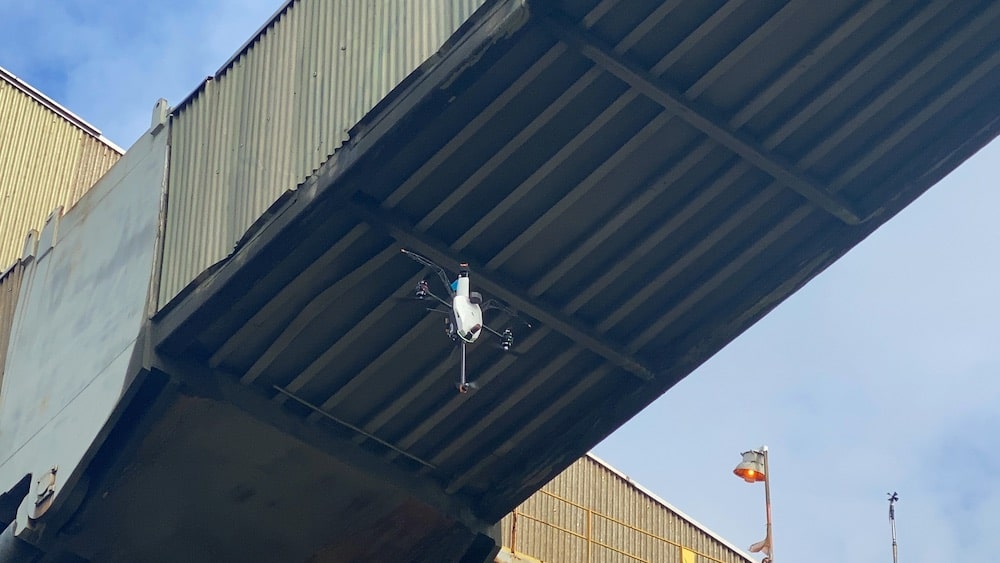
Source: Industrial drone performing ship loader inspection for signs of corrosion.
Thermographic Inspection
Thermal imaging cameras pick up temperature variations across surfaces, which can signal delaminations, cracks, or unusual heat dissipation patterns. In heat exchanger tubing, uneven thermal readings point to a potential leak. For large mechanical equipment like electric motors, pumps, and turbines, overheating is a telltale indicator of friction or misalignment that warrants further investigation.
Despite their effectiveness, thermal scans can be affected by environmental variables such as ambient temperature, humidity, or direct sunlight. Lower-resolution thermal cameras may fall short on detail when localizing defects in expansive structures. Moreover, HD thermal scanning systems carry a significant cost for installation and calibration, which narrows their range of practical applications.
Fluorescent Penetrant Inspection (FPI)
Non-porous materials — including metal, plastic, ceramic, and composites — can be examined using fluorescent penetrants in a dye-based process. When applied to a clean surface, the fluorescent dye penetrant seeps into surface discontinuities such as cracks and porosities. A powder or aerosol developer agent is then applied, making it possible for inspectors to see the size, shape, and severity of discontinuities under ultraviolet light.
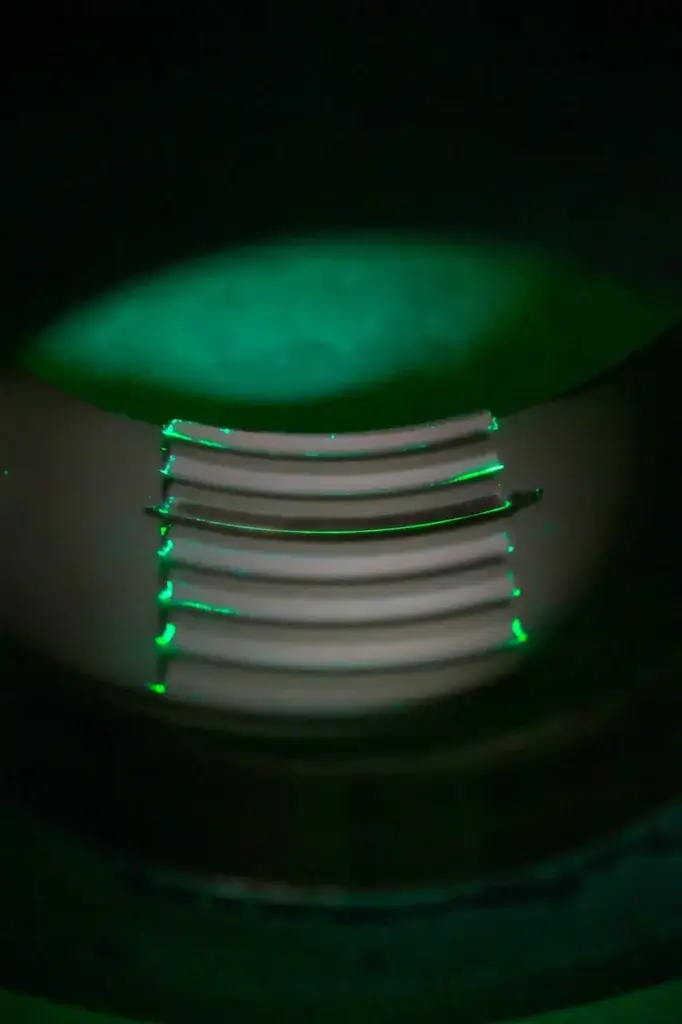
Source: Fluorescent penetrant test under UV light showing surface anomalies.
FPI is highly effective at detecting fine surface cracks and discontinuities in structures and non-porous components. However, the testing process can be both costly and labor-intensive when large surface areas need to be covered.
Magnetic Particle Inspection (MPI)
Magnetic particle inspection is a proven technique for examining ferromagnetic assets for surface and near-surface defects that are oriented perpendicular to the applied magnetic field.
MPI follows a process similar to fluorescent penetrant inspection but substitutes magnetic particles for dyes. The inspector first magnetizes the object, then applies fine iron particles or magnetic ink to the surface. The magnetic force naturally draws particles toward areas where the field is disrupted, highlighting potential flaws. This makes it an excellent choice for detecting cracks, inclusions, voids, and other irregularities in iron, steel, or nickel welds, castings, and forgings.
On the other hand, MPI requires physical contact with the surface for particle application, which limits its usefulness for hard-to-reach assets like tall metal chimneys. It is also less effective for inspecting very large industrial assets such as metal storage tanks.
Surface Roughness and Thickness Measurements
Changes in surface texture — such as skewness or kurtosis — often serve as indicators of developing problems. Visual inspections supported by instruments like profilometers or surface roughness testers can help identify irregularities in an asset's roughness profile, distinguishing between normal and abnormal conditions.
Likewise, handheld or remotely operated instruments allow you to measure the thickness of materials, coatings, or layers. Micrometers and calipers work well for small assets, while ultrasonic transducers and magnetic induction probes offer deeper penetration and are better suited for scanning larger structures. With a drone fitted with an ultrasonic transducer, for example, you can capture up to 200 thickness readings per hour in difficult-to-access areas like the interiors and exteriors of storage tanks, flare stacks, and chimneys.
Recommended Visual Testing Equipment
When choosing visual testing equipment, there are three key considerations to keep in mind: the inspection method (direct or remote), the operating conditions (such as high temperatures or corrosive environments), and the geometry and overall dimensions of the object being tested.
For work at elevated heights or on structures with complex geometries, remote visual testing is generally the best approach. For smaller-scale assets or individual components, direct inspection techniques tend to be more cost-effective.
Regardless of your approach, always factor in the technical specifications of the equipment — including the required resolution, measurement precision (e.g., in millimeters or micrometers), and whether color or monochrome imaging is appropriate. Consulting with the inspection service provider about available options is always a smart step.
HD Cameras
Cameras remain the primary tool in visual inspection. Handheld or mounted action cameras and pan-tilt-zoom (PTZ) cameras are widely available. Modern endoscopes and borescopes deliver high-resolution images from hard-to-reach locations, and thermal imaging cameras provide precise thermal readings. CCTV systems can be used for monitoring hazardous operations, though they typically offer lower resolution and a more limited viewing angle due to fixed camera positions.
In quality control settings, manufacturers are increasingly turning to industrial machine vision camera systems for automated defect detection powered by pre-trained algorithms. Major automotive manufacturers, for example, use AI-driven quality assurance systems to spot production defects in flat sheet metal components for car bodies. These applications can identify issues like cracks and delaminations in real time, and even differentiate between harmless pseudo-defects (such as dust particles or oil residue) and genuine micro-cracks — reducing unnecessary production delays.
Drones
Drones equipped with full 360-degree aerial mobility enable inspectors to reach the most inaccessible assets and carry out close-to-surface inspections at height. Modern inspection drones come outfitted with a variety of sensors, HD cameras, and even specialized cameras that capture visual data from different perspectives. They cover vast areas rapidly and efficiently, slashing the time and resources required when compared to traditional methods. Purpose-built inspection drones are designed for 360-degree mobility and exceptional stability, enabling a single operator to inspect 10 to 12 wind turbines per day with only one asset stop — saving operators hours of downtime.
Drones are also highly cost-effective for large-scale or repetitive inspections. They eliminate the need for scaffolding or lifting equipment to access remote but operationally critical locations. One industrial engineering firm reportedly saved over $165,000 on a routine asset inspection by using drones instead of conventional rope access methods.
With purpose-built inspection drones, you can navigate complex geometries — including curved, angled, or sloped surfaces — while collecting precise thickness, texture, and measurement data without requiring extended asset downtime.

Borescopes and Endoscopes
Borescopes and endoscopes are indispensable instruments for inspecting narrow passages, sealed chambers, and internal cavities within various products. In the aerospace and automotive sectors, borescopes are widely used to evaluate the condition of engines, fuel tanks, and wheel wells for signs of fatigue or damage.
Leading engine manufacturers have developed intelligent borescope solutions that leverage computer vision technology to automatically analyze visual imagery for signs of wear. These advanced tools can reduce engine inspection times by up to 75%, potentially saving airlines substantial amounts in inspection costs over a five-year period.
In industrial engineering and manufacturing, endoscopic analysis identifies leaks, blockages, and damage within pipes, tubes, and ducts. Flexible insertion tubes enable endoscopes to navigate tight spaces where rigid instruments simply cannot reach.