


 Damage
  Loss
Loss  Theft
Theft 


The Complete Guide to Ceiling Cassette Air Conditioners
- Why a Ceiling Cassette AC Is the Best Long-Lasting Solution for Modern Spaces
- What Is a Cassette AC?
- The Advantages of Ceiling Cassette ACs Over Other Types
- How Ceiling Cassette ACs Work
- Carrier Highlights for Multiple-Body Needs
- Are There Any Disadvantages to Ceiling Cassette Units?
- The Benefits of Opting for 24/7 WiFi Control
- Comparing Costs: Upfront vs. Long-Term
- What to Look for in a Ceiling Cassette AC
- Installation Tips for Ceiling Cassette Units
- How to Maintain Your Ceiling Cassette AC
- Frequently Asked Questions
Why a Ceiling Cassette AC Is the Best Long-Lasting Solution for Modern Spaces
When it comes to cooling large open areas — commercial offices, showrooms, server rooms, or upscale residences — few systems match the efficiency and elegance of a ceiling cassette air conditioner. Flush-mounted and virtually invisible from below, these units distribute conditioned air evenly in every direction, eliminating the hot and cold pockets that plague traditional wall-mounted systems.
If you've ever walked into a perfectly climate-controlled space and wondered how it stays so consistently comfortable without a visible unit on the wall, there's a strong chance a ceiling cassette was quietly doing the work from above.

Designed to Disappear Into Your Ceiling
The hallmark of the ceiling cassette is its discreet integration. Only the decorative panel — typically a clean white grille — is visible from the room. The entire mechanical assembly sits above the ceiling tile, preserving the architecture of your space while delivering powerful, consistent cooling or heating.
What Is a Cassette AC?
A cassette air conditioner is a type of ductless mini-split system where the indoor unit is recessed into the ceiling. Unlike a standard wall-mounted split, the cassette unit distributes airflow through vents positioned around all four sides of its panel, creating a 360° airflow pattern that blankets the entire room evenly.
Cassette systems typically require a suspended or drop ceiling with enough plenum space to accommodate the unit's depth, along with an outdoor compressor connected via refrigerant lines. They are available in a wide range of capacities, making them suitable for everything from a single office to a large multi-zone commercial building.
The Advantages of Ceiling Cassette ACs Over Other Types
Even Air Distribution
Four-way airflow eliminates temperature imbalances across the room, no matter the layout.
Space-Saving Design
Zero wall space consumed. The unit is fully recessed, freeing your walls for windows, artwork, or shelving.
Energy Efficiency
Inverter-driven compressors adjust output to match demand, reducing energy consumption significantly.
Aesthetic Appeal
A slim decorative grille is all that's visible. Perfect for upscale residential and commercial interiors.
Whisper-Quiet Operation
Indoor noise levels as low as 29 dB(A), comparable to a soft whisper — barely perceptible during operation.
Heating & Cooling
Heat pump models provide year-round comfort, handling both summer cooling and winter heating from one unit.
How Ceiling Cassette ACs Work
Ceiling cassette systems operate on the same refrigerant cycle as any other split-system air conditioner, but their distinguishing factor is the indoor air handler's position and airflow delivery. The indoor cassette unit draws warm room air through a central intake at the panel's core and passes it over refrigerant coils. The cooled air is then pushed outward through adjustable louvers on the panel's four sides.
This 360° distribution means the system doesn't depend on a single throw direction to condition a room. Instead, it creates a gentle, cascading curtain of conditioned air that settles evenly across the floor level, reducing stratification and maintaining a consistent temperature throughout the space.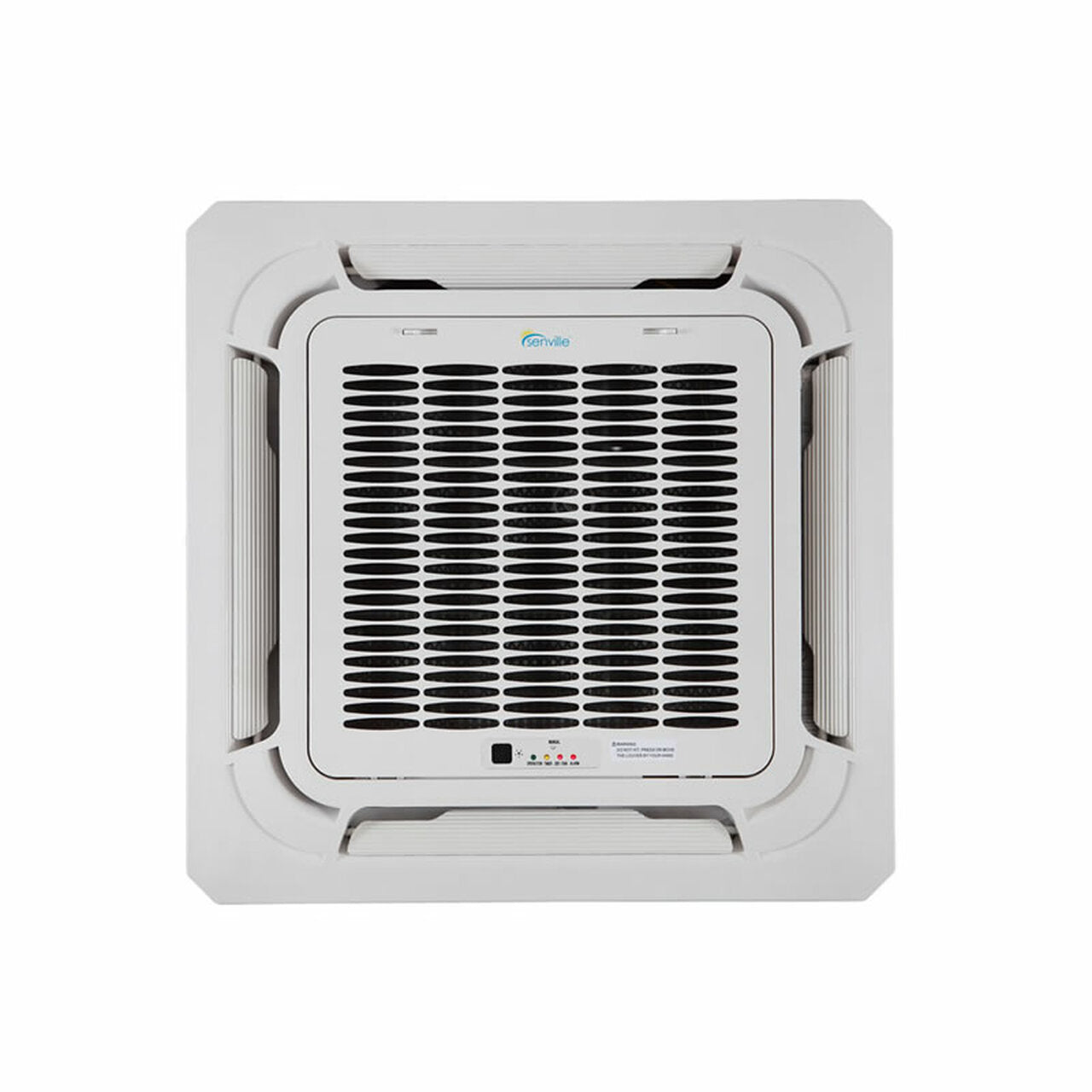
Inverter Technology Makes the Difference
Modern ceiling cassette units equipped with inverter compressors don't simply switch on and off like older fixed-speed systems. Instead, they ramp up and down continuously to match real-time cooling or heating demand. This variable operation not only saves energy but also maintains more precise temperature control and reduces wear on mechanical components — extending the unit's service life considerably.
Carrier Highlights for Multiple-Body Needs
When selecting a ceiling cassette system, comparing core performance metrics helps you make the right choice for your space. Here's how key specifications stack up across common configurations:
| Feature | Entry Level | Mid Range | Premium |
|---|---|---|---|
| BTU Capacity | 9,000 – 12,000 | 18,000 – 24,000 | 28,000 – 36,000 |
| SEER Rating | Up to 16 | Up to 20 | Up to 25+ |
| Airflow Direction | 2-Way | 4-Way | 4-Way Auto-Swing |
| WiFi Control | Optional | Included | Included |
| Heat Pump | Some models | Most models | Standard |
| Refrigerant | R-410A | R-32 / R-410A | R-32 |
Are There Any Disadvantages to Ceiling Cassette Units?
Like any HVAC technology, ceiling cassette systems come with trade-offs. Understanding both sides helps you invest wisely and set realistic expectations for your installation.
- Uniform, 360° temperature distribution
- Completely hidden — only grille panel visible
- Dual-function heating and cooling year-round
- Exceptionally quiet indoor operation
- Highly energy-efficient inverter technology
- Compatible with multi-zone systems
- Long operational lifespan with proper care
- Requires a suspended or drop ceiling
- Higher upfront cost than wall-mounted units
- Professional installation is mandatory
- Limited DIY maintenance access
- Adequate plenum depth required above ceiling
- Condensate drain line must be properly routed
The Benefits of Opting for WiFi-Enabled Control
Smart connectivity has transformed how building owners and homeowners manage their climate systems. A ceiling cassette unit with built-in WiFi control gives you the ability to monitor and adjust your environment from anywhere in the world through a dedicated app — whether you're heading home early on a hot afternoon or managing a commercial property remotely.
Schedule, Monitor, and Save
WiFi-enabled units allow you to set precise temperature schedules around occupancy patterns, avoiding energy waste during unoccupied hours. Many platforms provide energy usage reports so you can track consumption trends and identify savings opportunities. Combined with the unit's inverter compressor, smart scheduling can translate into meaningful reductions on your monthly energy bill.
Voice assistant compatibility — including Amazon Alexa and Google Home — adds another layer of hands-free convenience, making smart cassette systems a natural fit for modern smart-home ecosystems.
Comparing Costs: Upfront vs. Long-Term
The initial purchase and installation cost of a ceiling cassette system is higher than that of a basic window unit or even a standard wall-mounted mini-split. However, when total cost of ownership is considered over a 10- to 15-year lifespan, ceiling cassette systems consistently deliver superior value through reduced energy consumption, lower repair frequency, and elimination of ductwork maintenance costs.
A Simple Way to Think About It
Short term: Ceiling cassette systems carry a higher purchase and installation price. Budget for professional installation by a certified HVAC technician, which adds to your Day 1 cost but ensures the system operates at peak rated efficiency from the start.
Long term: Superior SEER ratings translate to lower monthly electricity bills. Heat pump functionality means you don't need a separate heating system. Inverter compressors are gentler on components, reducing breakdown frequency and extending the unit's useful life well beyond that of conventional equipment.
What to Look for When Choosing a Ceiling Cassette AC
With so many models available, narrowing down your options requires evaluating the features most relevant to your specific application. Here are the critical factors to consider before purchasing:
- BTU Capacity: Match cooling/heating output to your room's square footage. Oversized units short-cycle; undersized units run continuously. Use a load calculation for accuracy.
- SEER & HSPF Ratings: Higher seasonal energy efficiency ratios mean lower operating costs. Look for SEER 20+ for maximum long-term savings.
- Heat Pump Capability: A dual-function unit eliminates the need for a separate heating solution, simplifying your HVAC setup and reducing overall cost.
- WiFi & Smart Controls: Native app control, scheduling, and smart-home integration enhance convenience and enable energy optimization.
- Noise Level: Check the indoor dB(A) rating. For bedrooms or quiet offices, look for units rated below 32 dB(A).
- Refrigerant Type: R-32 refrigerant has a lower global warming potential than R-410A and is more energy-efficient, making it the preferred choice for environmentally conscious buyers.
- Warranty: Look for at minimum a 5-year parts and compressor warranty. Industry-leading brands offer up to 10 years when registered.
- Auto-Clean & Self-Diagnosis: Built-in filter cleaning and fault-code diagnostics reduce maintenance burden and simplify troubleshooting.
Installation Tips for Ceiling Cassette Units
Proper installation is the single most important factor in a ceiling cassette unit's long-term performance. A poorly installed system — regardless of the equipment's quality — will underperform, consume more energy, and fail prematurely. Here's what to know before installation day
:
Ceiling Clearance and Plenum Space
Ensure your ceiling cavity provides sufficient depth for the unit's housing. Most residential cassette units require 10 to 14 inches of plenum space above the ceiling tile. Measure carefully before ordering your equipment, as retrofitting tight spaces adds significant cost and complexity.
Electrical Requirements
Most 24,000 BTU and larger cassette units require a dedicated 208–240V circuit. Confirm your electrical panel has the capacity and that a licensed electrician runs the dedicated line before the HVAC technician arrives. Attempting to share circuits with other high-draw appliances will result in nuisance tripping and potential equipment damage.
Condensate Drainage
All cassette units produce condensation during cooling operation. A properly sloped condensate drain line must route moisture away from the unit to a floor drain, exterior, or condensate pump system. Neglecting the drain line is one of the most common causes of ceiling water damage and mold growth associated with poorly installed cassette systems.
Refrigerant Line Routing
Refrigerant lines should be routed with minimal bends and kept as short as reasonably possible between the indoor cassette and the outdoor condenser. Excess line length reduces system efficiency and increases the risk of refrigerant pressure issues over time. Always have a certified HVAC technician handle refrigerant charging.
How to Maintain Your Ceiling Cassette AC
Routine maintenance is what separates a ceiling cassette system that performs well for 15+ years from one that struggles past the five-year mark. Most maintenance tasks are straightforward and can be handled by the property owner, while others require a professional visit once or twice per year.
Owner Maintenance Checklist
- Clean or replace air filters every 4–6 weeks during heavy use periods.
- Wipe down the decorative panel grille monthly to prevent dust buildup in airflow louvers.
- Inspect the condensate drain pan for standing water or debris quarterly.
- Check that the outdoor condenser unit is free from vegetation, debris, and restricted airflow.
- Listen for unusual sounds — rattles, grinding, or banging — that may indicate a loose component.
Annual Professional Service
Schedule a certified HVAC technician for an annual inspection covering refrigerant level verification, coil cleaning, electrical connection tightening, and a full system performance test. Professional maintenance catches minor issues before they escalate into costly repairs and ensures your system continues operating at its rated SEER efficiency year after year.
Frequently Asked Questions
Can a ceiling cassette AC work in a room without a drop ceiling?
While cassette units are designed for suspended ceilings, custom solutions exist for solid concrete or drywall ceilings — but they involve significant structural work and are generally not cost-effective. For rooms without drop ceilings, a high-wall mini-split or floor-mounted unit is usually the more practical alternative.
How long does a ceiling cassette AC typically last?
With proper installation and regular maintenance, a quality ceiling cassette system will typically provide 15 to 20 years of reliable service. Inverter-driven compressors, which run more gently than fixed-speed units, tend to outlast older technology by a considerable margin.
Is a ceiling cassette system more efficient than a ducted central air system?
In most cases, yes. Ductwork in central systems is responsible for losing up to 30% of conditioned air through leaks and thermal transfer losses. Ductless cassette systems deliver conditioned air directly into the room, eliminating that loss entirely. When comparing equivalent BTU capacities, ductless systems almost universally achieve higher effective efficiency under real-world conditions.
What size cassette unit do I need for my space?
A general rule of thumb is approximately 20 BTU per square foot of cooled space, adjusted for ceiling height, insulation quality, window area, sun exposure, and occupancy levels. For precise sizing, consult an HVAC professional who can perform a proper Manual J load calculation for your specific space.