


 Damage
  Loss
Loss  Theft
Theft 


Moving Dolly: A Man’s Best Friend During a House Move

Highlights
- The moving dolly is the most useful investment in any home-moving kit. It can help you move heavy furniture, bulky appliances, stacked boxes, and much more.
- There are four primary types of moving dollies — utility dollies, appliance dollies, and furniture dollies — each designed for a different purpose and use case.
- In order to achieve maximum safety while lifting during your move, you need to choose the right type of dolly for your needs and know how to use it the right way.
Table of Contents
- How to choose the right dolly for your move
- Utility dolly
- Appliance dolly
- Furniture dolly
- Dolly prices
- Choosing a moving dolly
- How to use a moving dolly
- Tips on how to use a dolly safely
Getting the right tools for a job makes the job easier — everyone understands that. What most people overlook, however, is that the right tools for a professional task can also serve as the right tools for a personal one — like moving house.
When it comes to relocating, there are many practical pieces of equipment that can make the process faster, safer, and smoother. Moving straps, moving blankets, furniture sliders, and similar supplies are all incredibly helpful — but the dolly is arguably the most essential tool on any moving day.
Moving dollies help you transport everything — from tables and bookshelves to refrigerators and heavy crates of tools. Whatever the shape or size of the object, the properly selected dolly can save your time, protect your spine, and ensure the safety of your possessions.
You just need to pick the right dolly for the task — and understand how to use it correctly every time.
How to Choose the Right Dolly for Your Move
Moving dollies are often described as a mover’s best friend. But what exactly is a dolly and what does it do?
A dolly for moving — also referred to as a hand truck — is essentially a platform on wheels. It distributes the weight of heavy items so that one or two people can transport loads that would otherwise strain the body and increase the risk of damage and injuries during a move.
Using a dolly allows you to move several boxes at once, carry items that weigh hundreds of pounds, navigate over uneven surfaces, and ensure that items stay put and don’t shift. It speeds up the moving process considerably, a shared load makes for more efficient transporting — taking items to the van and from it faster. It also lessens the chance of injury, and therefore reduces the risk of expensive items falling, breaking, or getting scratched.
Quality moving dollies are made of material like steel so they can withstand heavy weight, and usually come with a strap so the load can be safely secured. They may have solid rubber wheels fitted for moving heavy objects across flat surfaces or inflatable wheels designed for crossing over obstacles such as uneven terrain and debris-strewn areas.
There are different categories of dollies and each type is suited toward a specific purpose and has its own unique advantages.
Utility Dolly

When thinking of a dolly, the image that first comes to mind is a two-wheeled, upright hand truck. This is a great representation of the standard utility dolly — it’s extremely versatile, very easy to use, and highly reliable.
Typically made of aluminum or solid steel, utility dollies have tall vertical backs and small horizontal platforms at the bottom where you set the load. You lean and tilt the platform from the wheels’ range of motion to slide under the cargo and tip it back.
Basic and mid-range wheeled carts — or hand trucks — usually have two large pneumatic wheels connected to an axle that act as pivots, which allow easy steering over obstacles. You can safely stack your boxes on top of the platform and strap them securely, and use a padded handle at the top to comfortably navigate corridors or ramps.
Most models come with double-stacker clamp straps for ensuring the load is fastened to the frame of the cart, making it much safer in transit.
Key takeaway: Generally, utility dollies can handle several hundred pounds of weight — the standard load capacity of a hand truck is around 600 lbs. You’ll however attempt to always check the maximum carrying capacity of a dolly before using it, as each model is different — a heavy-duty utility dolly can withstand up to 1,000 lbs, while a folding dolly can offer roughly 150 lbs of capacity.
Key takeaway: The utility dolly is an all-purpose dolly, widely considered the best dolly for moving. Its ideal for transporting boxes, small cabinets, stacked cartons, and all kinds of small-to-medium-sized packaged items. If you’re only going to invest in one dolly and need a more general-use solution, you’ll find that standard hand trucks perform brilliantly for the big majority of residential and small business moves. Line items up on their plate, strap them in securely, and easily maneuver your load into tight spaces and around sharp corners. A hand truck, ideally, should not be used for items heavier than its rated capacity or oddly shaped items.
Appliance Dolly
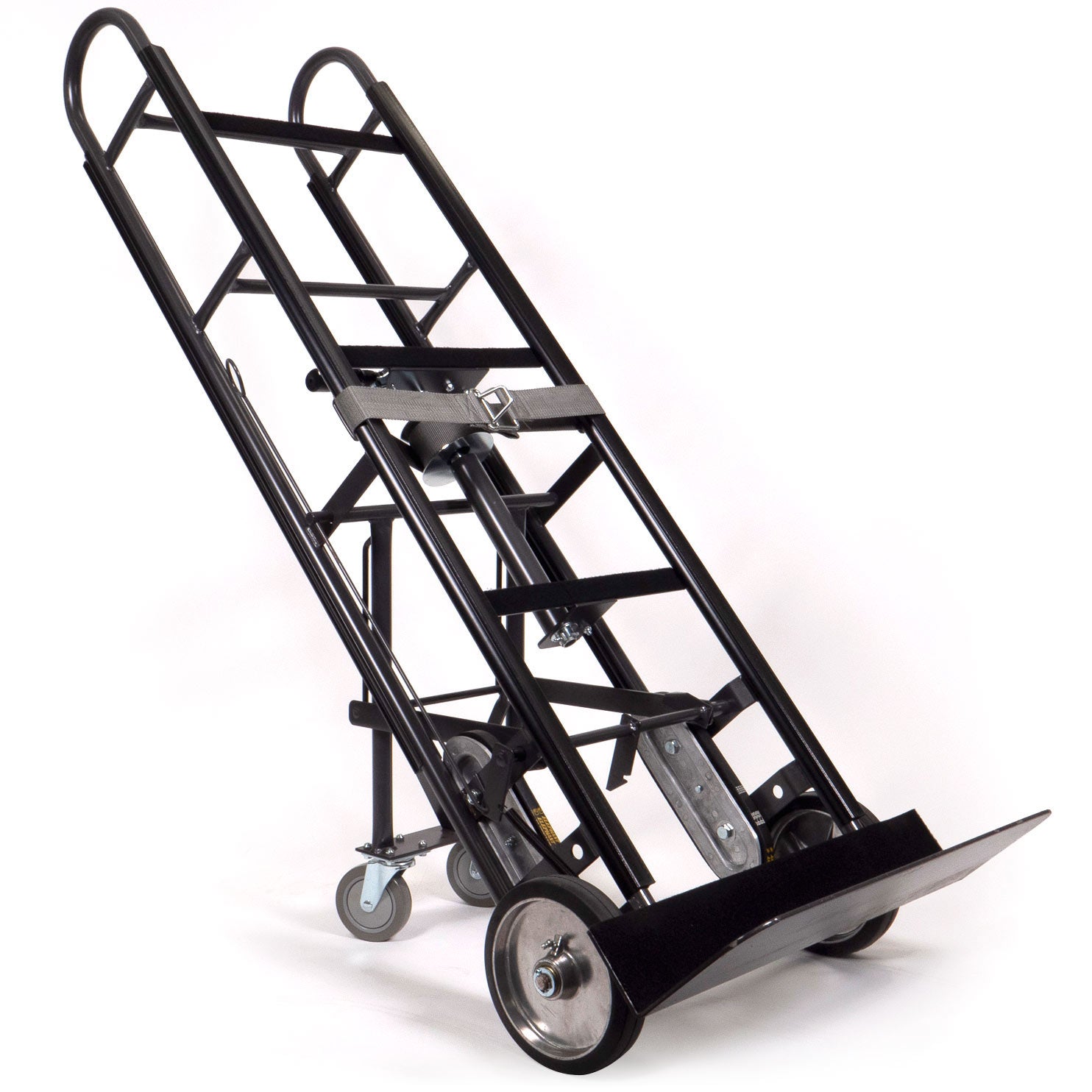
Appliance dollies are very similar in appearance and structure to utility dollies, but they tend to be taller, wider, and stronger.
Specifically designed for transporting big, heavy appliances, such as refrigerators, washers, and dryers, appliance dollies are made of steel and often reinforced with greater weight ratings (for instance some heavy-duty models can handle up to 1,800 lbs, but more typically these heavy-duty units can handle up to 1,200 pounds).
Appliance dollies typically have tall upright sections to fit items more securely and carry extra-wide rubber-tipped wheels so that the load is stable. Some models even feature a locking stair-crawl mechanism or a special tightening handle for increased safety.
Most appliance dollies have built-in ratchet straps that fasten the items to the dolly with control, and some even come with an additional furniture belt to help keep everything in fixed and secure during transport.
Key takeaway: Quality appliance dollies have rail locks as well — to protect the finish of the transported appliance.
The best time to reach for an appliance dolly is when you have the choice over moving kitchen appliances and other bulky items. When selecting the appliance dolly or utility dolly for a specific move, keep in mind that the appliance dolly will typically be the better choice if your load weighs more than about 500 lbs, or if the item is a large or awkwardly-shaped appliance. It is more engineered in construction and delivers superior performance in such circumstances as a utility dolly.
Furniture Dolly

The furniture dolly is a flat, low-profile dolly with a wide rectangular or square surface and four small swivel wheels at each corner. The platform is typically carpeted or covered with non-slip rubber for added surface protection, offering the moved piece of furniture extra grip and preventing the transported furniture from sliding and potentially suffering other surface damage.
Unlike other vertical, upright-style dollies, furniture dollies have handles on both sides — or, in many cases, no handles at all since you simply push or guide the item where it needs to go once it’s placed on the platform.
Key takeaway: Furniture dollies can handle up to a thousand pounds, allowing you to easily move large and heavy furniture pieces in one flat, stable setup. It’s no wonder why there is no rival to the furniture dolly when it comes to sliding a heavy object safely from point A to point B. A flatbed, low-center dolly controls the weight and doesn’t tip over.
Furniture dollies are best suited for moving wood furniture, large wardrobes, appliances, specialty items like pianos, and other pieces of heavy or large gear. Consider the items you have for moving — wood furniture, large wardrobes, appliances, specialty items — and the particular size of your cargo and destination. Knowledge of the route, tight corners, stairs, and other obstacles will help guide the right model and you can usually find a furniture dolly to match any specific moving challenge — get a flat dolly if you need it for moving heavy furniture, a board truck if you need to haul your items at an angle or down a stairwell, or maybe an adjustable dolly if you have multiple different pieces you need to handle.
Dolly Prices
When shopping for your dolly, keep in mind that the specifics of different types of dollies mean that each model will come at a unique price. So how much does a dolly cost?

Dolly prices are not exactly sky-high — you can often find a dolly at a cost that is well within reach for the type of person who can get real value from it.
- Furniture dollies are the cheapest of all moving dolly types. You can purchase a simple flat dolly for as little as $20. Higher quality or durable furniture dollies can also be found around the $50 to $100 range, depending on the exact specifications and features.
- Hand trucks or utility dollies typically range between $30 and $150 depending on brand, capacity, and build quality. A reliable mid-range utility dolly will run around $50 to $80 for solid construction quality.
- Utility dolly prices can go around $50 for the quality of the push cart on the lower end to $100+ for heavier-rated units, while lightweight, fold-up varieties can run as low as about $30.
- Appliance dollies are a bit pricier — depending on the exact model, they can cost anywhere from $70 to upwards of $200 or more. The price tag reflects the heavier-duty build and specialized features. You can often find a highly rated appliance dolly but to get one on the day of your move, you can borrow, rent, or pay about $30–$50 a day to hire one.
Choosing a Moving Dolly
Dollies come in different shapes and sizes — you can get a two-wheeled dolly or a four-wheeled dolly, a flat dolly or an upright dolly, a collapsible dolly or a convertible hand cart or a specialty dolly for a single job. Only you can choose the right dolly for the specific task you need help with.
Consider the items you need to transport — wood furniture, large wardrobes, appliances, specialty items like pianos — and the particular size of your cargo and destination. Knowledge of the route (hallways, tight corners, stairs) and the specific floor types you’ll encounter will also help you make the right pick. You want a dolly that won’t scuff your floors, a dolly that turns tight corners, and a dolly that can also be safely used on stairs if required.
The main objective when selecting any moving dolly — regardless of which category or model you settle on — is to make your move as easy and safe as possible.
To do so, recognize you need to not only choose the right dolly for the job, but also learn how to use it the right way.
How to Use a Moving Dolly

Learning to properly handle a moving dolly is not complicated, but it does require you to follow some essential steps in order to protect yourself and your belongings.
Prepare the load. Before placing anything on the dolly, make sure each item is securely wrapped, padded, or boxed. Use moving blankets around delicate furniture. Tape boxes shut. The goal is to prevent shifting and scratching while in transit.
Load the dolly properly. Slide the lip of the dolly plate underneath the item. For upright dollies, tilt the item back toward you until the weight rests against the back frame. For flat dollies, lift the item onto the platform and center it carefully.
Strap it down. Use the dolly’s built-in straps or bring your own ratchet straps to secure the load to the frame. Never transport unsecured items — even a small shift can create a dangerous imbalance.
Tilt and roll. Lean the dolly back toward you at roughly a 30–45 degree angle so the weight is balanced between you and the wheels. Push forward and let the wheels do the work. Keep your back straight and push with your legs.
Navigate obstacles with care. If you encounter stairs, bumps, or thresholds, take them one step at a time and always have a partner spotting you from the opposite side. Never rush stairs with a loaded dolly.
Tips on How to Use a Dolly Safely
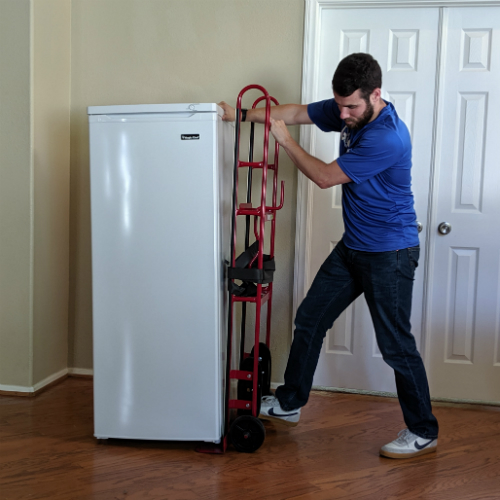
Check Weight Limits
Always verify the maximum weight rating of your dolly before loading it. Exceeding the capacity risks equipment failure and personal injury.
Wear the Right Gear
Wear closed-toe shoes with good grip, gloves for a firm hold, and avoid loose clothing that can get caught in wheels or straps.
Clear the Path
Before you start moving, walk the route and clear any obstacles — rugs, cords, toys, debris. A clear path prevents tipping and reduces the risk of accidents.
Use a Spotter
For heavy or bulky loads, always have a second person guiding and spotting. Stairs especially require two people working in coordination.
Push, Don’t Pull
Pushing a loaded dolly gives you more control and puts less strain on your back. Only pull when navigating the dolly through a doorway or tight spot.
Inspect Before Use
Check the tires, straps, frame, and wheels before every use. A flat tire or a loose bolt can turn a simple move into a disaster.
Ready to Make Your Next Move Easier?
Equip yourself with the right dolly and turn a stressful move into a smooth operation. Browse our selection of professional-grade moving equipment.
Sumner Cricket Pipe Dolly