


 Damage
  Loss
Loss  Theft
Theft 


3 Best Incline Bench Exercises for Abs
Key Takeaways
- An incline bench adds gravitational resistance to standard ab moves, intensifying core activation and promoting faster strength gains compared to flat-surface training.
- Incline leg raises, Russian twists, and weighted crunches form a comprehensive trio that targets the lower abs, obliques, and upper rectus abdominis respectively.
- Proper bench angle selection — typically between 30 and 45 degrees — is crucial for balancing challenge with correct form.
- Progressive overload through angle adjustments, added weight, and volume increases keeps your core development on an upward trajectory.
- These exercises suit all fitness levels when scaled with the right modifications.
How Incline Bench Training Transforms Ab Development
Most people associate ab training with floor crunches and planks, but those movements eventually hit a ceiling. The incline bench changes the equation entirely by leveraging gravity as an adjustable resistance tool. When your torso is positioned on a decline relative to your hips, every contraction has to overcome a greater gravitational pull — and that added demand translates directly into deeper muscle fiber recruitment across the entire abdominal wall.
Research in exercise science consistently highlights the incline bench as one of the most effective platforms for core isolation. Unlike cable machines or resistance bands, the bench provides a stable base that lets you focus entirely on the quality of each repetition. The result is a stronger mind-muscle connection, reduced reliance on momentum, and measurably better outcomes over time.
Below, we break down three incline bench exercises that collectively cover every region of your abdominals — from the deep lower fibers to the obliques and the upper six-pack muscles. Each movement includes step-by-step instructions, programming recommendations, and level-appropriate variations so you can start benefiting immediately.
Muscles Targeted With Incline Bench Ab Work
Exercise 1: Incline Leg Raises
Primary Target — Lower Abdominals

The incline leg raise is arguably the single best movement for isolating the lower portion of the rectus abdominis. Lying on a decline bench with your head at the high end forces your lower abs to work overtime as they lift the weight of both legs against gravity. Unlike flat-surface leg raises, the incline version eliminates the "dead zone" at the bottom of the movement, maintaining constant tension on the target muscles.
How to Perform
- Set your adjustable bench to a 30–45 degree decline angle. Lie back with your head at the elevated end, gripping the top of the bench or its handles firmly for stability.
- Begin with your legs extended, hovering just slightly off the bench surface. Keep a very slight bend in your knees to protect the lower back.
- Exhale and raise both legs in a controlled arc until they point toward the ceiling (or as high as your mobility allows). Focus on curling the pelvis upward at the top to maximize lower ab contraction.
- Lower your legs slowly — take at least two full seconds on the descent — stopping just before they touch the bench. That brief pause at the bottom preserves tension and completes one repetition.
Programming
Start with three sets of 10–15 repetitions. Rest 45–60 seconds between sets. As you build strength, increase to four sets and slow the eccentric phase to three seconds per rep before adding ankle weights or holding a light dumbbell between your feet.
Variations by Level
Beginner
Perform bent-knee raises at a shallow incline (around 20 degrees) with a limited range of motion. Build up to full leg extension over several weeks.
Intermediate
Straight-leg raises at 30–40 degrees with a three-second negative. Add a brief hold at the top position for extra contraction.
Advanced
Weighted leg raises at a steep decline with a medicine ball between the ankles. Combine with a hip thrust at the top to engage the full abdominal chain.
Exercise 2: Incline Russian Twists
Primary Target — Obliques & Rotational Core
Russian twists are already a proven oblique-builder, but performing them on an incline bench takes the exercise to a different level entirely. The bench provides a locked-in hip position that prevents the common cheat of swaying the lower body, meaning virtually all of the rotational force passes through the obliques and the deep transverse abdominis. This exercise also builds the kind of functional rotational strength that translates to everyday activities and athletic performance.
How to Perform
- Set the bench to a 30–45 degree decline. Secure your feet under the foot pads and sit back so your torso is at roughly a 45-degree angle relative to the floor.
- Hold a weight plate, dumbbell, or medicine ball at chest height with both hands, arms slightly extended in front of you.
- Rotate your torso to the right, bringing the weight toward the bench surface beside your hip. Keep your hips square — only your upper body should rotate.
- Reverse the motion through center and continue to the left side. One complete left-and-right rotation equals one repetition.
Programming
Aim for three sets of 12–20 total twists (6–10 per side). Rest 45 seconds between sets. Speed should be moderate and controlled — the moment you start using momentum instead of muscle, the set is effectively over.
Weight Progression
Begin with bodyweight only or a very light plate (5 lbs). Once you can comfortably complete three sets of 20 reps at a given weight, increase by 2.5–5 lbs. Emphasize range of motion and control over load — a deep, slow twist with moderate weight will always outperform a shallow, fast twist with heavy resistance.
Exercise 3: Weighted Incline Crunches
Primary Target — Upper Rectus Abdominis

Weighted incline crunches are the finishing piece of a well-rounded incline bench ab routine. By placing external resistance across your chest or behind your head, you dramatically increase the demands on the upper portion of the rectus abdominis. The decline position prevents you from relying on hip flexor momentum — a common flaw with standard weighted crunches on the floor — so the upper abs bear the full brunt of every contraction.
How to Perform
- Secure your legs under the foot pads of a decline bench set to 30–45 degrees. Hold a weight plate against your chest or a dumbbell behind your head with both hands.
- Begin lying fully back on the bench. Engage your core and curl your shoulders and upper back off the bench, exhaling as you come up.
- Pause at the top of the crunch for one full second, squeezing the abs hard. Avoid pulling yourself all the way to a seated position — the movement is a curl, not a sit-up.
- Lower yourself back down under control, taking two to three seconds on the descent. Stop just before your shoulder blades fully rest on the bench to maintain constant tension.
Programming
Three to four sets of 10–15 reps works well for most trainees. Use a weight that makes the final two to three reps genuinely challenging while still allowing complete range of motion. Rest 60 seconds between sets. Increase the weight by small increments once you can cleanly complete four sets of 15.
Finding Your Optimal Incline Angle
The ideal bench angle depends on your current strength and experience. A shallower angle (around 20–30 degrees) reduces gravitational resistance and is best for beginners or during warm-up sets. A steeper angle (35–45 degrees) significantly increases the challenge and is suited for intermediate to advanced trainees. Experiment within this range and choose the angle where you can perform each exercise with textbook form while still feeling meaningful resistance by the end of every set.
Best Incline Bench Exercises for Abs: Summary Table
| Exercise | Target Area | Sets x Reps | Difficulty |
|---|---|---|---|
| Incline Leg Raises | Lower Abs | 3-4 x 10-15 | All Levels |
| Incline Russian Twists | Obliques | 3 x 12-20 | Beginner-Intermediate |
| Weighted Incline Crunches | Upper Abs | 3-4 x 10-15 | Intermediate-Advanced |
Build Stronger Abs with the Right Equipment
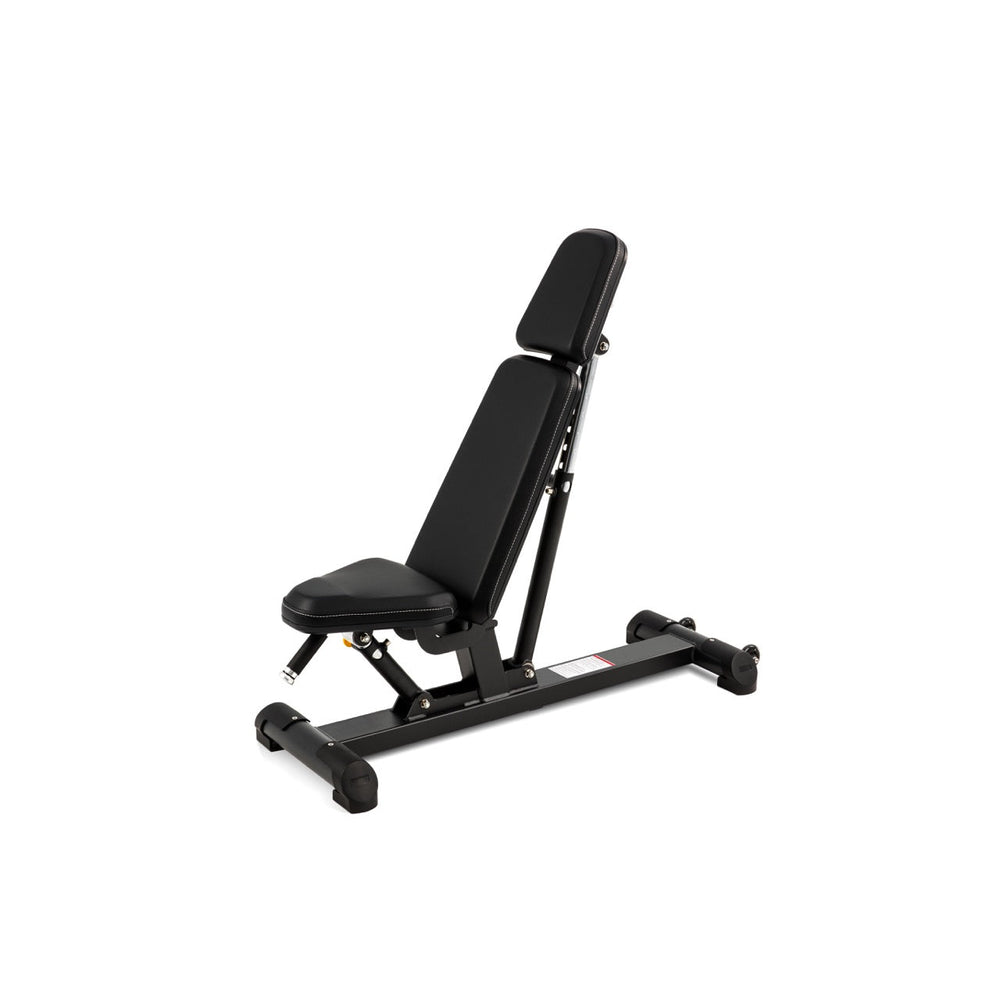
Having a quality adjustable bench at home removes every barrier between you and a consistent core training routine. A purpose-built ab trainer takes it a step further by offering ergonomic support, multiple angle settings, and the kind of build quality that keeps up with years of hard use. When your equipment is reliable and comfortable, you train more often — and results follow naturally.

The Total Gym ELEVATE Adjustable Core ADJ Trainer is engineered for exactly this kind of focused abdominal work. Its adjustable incline settings let you seamlessly progress through beginner, intermediate, and advanced angles without switching equipment, and the padded design keeps your spine supported through every repetition. If you are serious about transforming your midsection, this is the type of home gym investment that pays for itself in consistency and results.
Frequently Asked Questions (FAQs)
Can beginners safely perform incline bench ab exercises?
Absolutely. Beginners should start with a shallow bench angle (around 20 degrees) and use bodyweight-only versions of each exercise. Focus on mastering controlled form before increasing the angle or adding external weight. Bent-knee variations of leg raises and unweighted crunches are excellent entry points.
What incline angle is best for targeting lower abs?
A decline angle between 30 and 45 degrees places the greatest emphasis on the lower abdominals during leg raise variations. Steeper angles increase difficulty, so work your way up gradually. Ensure you can maintain a controlled, full range of motion at whatever angle you choose.
Will these exercises help me lose belly fat?
Ab exercises strengthen and build the abdominal muscles, but spot reduction of body fat is not physiologically possible. To reveal defined abs, you need to combine consistent core training with a caloric deficit through balanced nutrition and regular cardiovascular activity. These exercises will ensure the muscles underneath are well-developed and ready to show once your body fat percentage decreases.
How do I incorporate incline bench exercises into my existing routine?
Add these exercises at the end of your regular workout two to three times per week. Perform all three back-to-back as a circuit, or distribute them across different training days. Allow at least 48 hours of recovery between intense ab sessions. Pair them with compound lifts like squats and deadlifts for a holistic core development approach.
What equipment supports comprehensive incline bench ab training at home?
An adjustable decline bench is the essential piece. Beyond that, a set of light to moderate dumbbells or a medicine ball will cover all the weighted variations described above. Purpose-built adjustable core trainers, like the Total Gym ELEVATE series, provide built-in foot anchors, multiple incline positions, and padding that makes long ab sessions significantly more comfortable.